Quick verdict
The JL3MN is a useful compact pressure probe for an existing Job Link workflow. Its single pressure input is the key buying detail: plan the reference and the number of probes before expecting simultaneous differential measurements.
This is a research-based review of the exact model, using the linked official documentation and original buying analysis. We have not performed hands-on or comparative testing. Amazon customer reviews and star ratings are not reproduced or represented as independent evidence.
One input is an intentional design choice
The JL3MN is a single-port wireless manometer. Fieldpiece documents gas, static, and draft applications with dry, non-corrosive gas, a ±60 inWC range, and specified accuracy of ±0.02 inWC from zero to ±2 inWC. It connects to Job Link and can be placed close to the measuring point using short tubing and its magnet. Those facts define both its appeal and its limits.
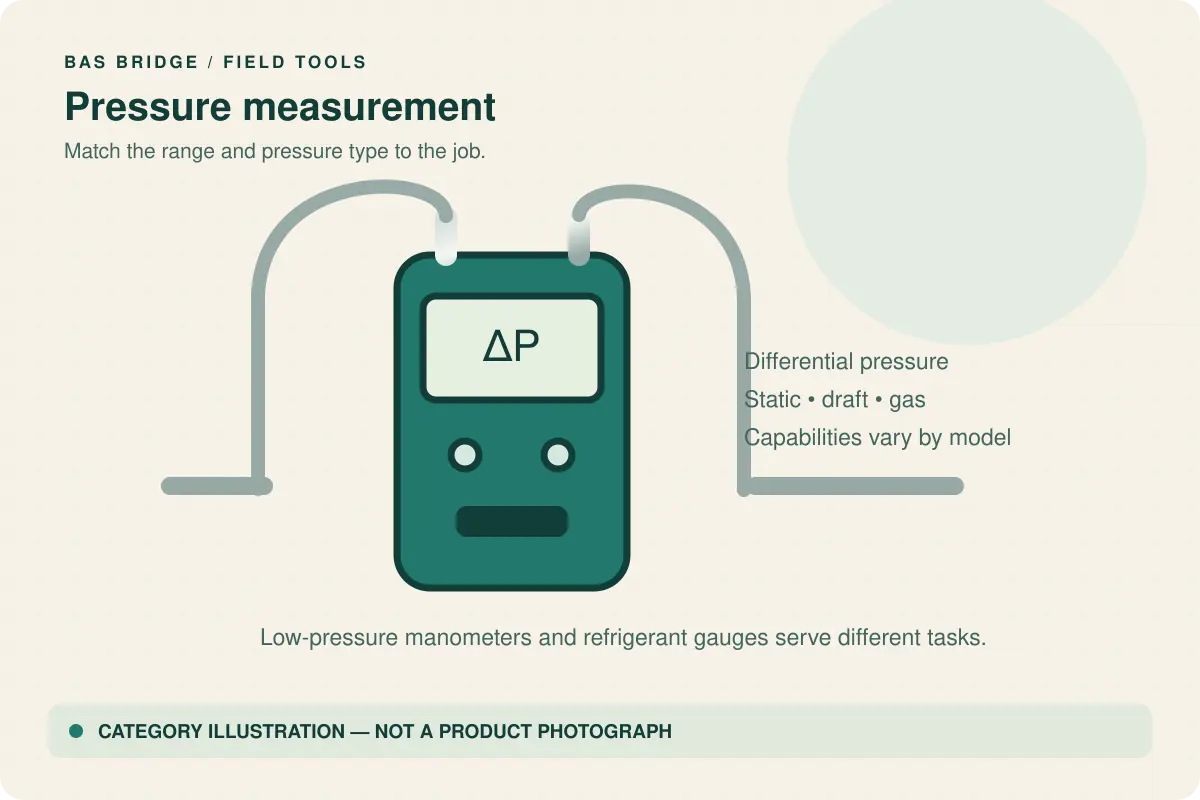
A single input is convenient when the measurement is referenced appropriately and the task needs one pressure observation. It is not the same physical arrangement as a dual-port manometer. Decide how the reference is established and whether two simultaneously observed points are required before assuming a single probe will complete the job.
Plan the measurement before buying the probe
For a pressure drop across a filter or coil, the useful result relates two locations under the same operating condition. Taking sequential readings may be reasonable in some stable circumstances, while simultaneous measurements may be preferable when the system changes. The correct tool count follows the method. The app cannot reconstruct a missing physical measurement simply because it can display a differential value.
For a single gas-pressure observation, a compact probe may be a good fit, but the connection and test-port requirements remain equipment-specific. Use the right adapter and protect the instrument from inappropriate media and pressure. This is a low-pressure gas instrument, so do not connect it directly to a hydronic circuit because both applications happen to use the word pressure.
Short tubing helps organization, not interpretation
Keeping the probe near the test port can reduce long loops of hose across a cabinet or aisle. Remote viewing is particularly appealing when the pressure must be observed from another position. We regard that as a plausible workflow benefit of the documented design, not as a measured time saving or a guarantee of site-wide radio coverage.
The reading still needs an identified location, sign convention, units, and operating state. Static pressure measured with an unsuitable probe orientation can answer a different question than intended. A correct number recorded in the wrong unit or assigned to the wrong side of a system is equally capable of leading the diagnosis astray.
Compare it with the SDMN6 and Testo 510i
The JL3MN is most compelling as an incremental purchase inside an existing Job Link kit. A dual-port instrument such as the SDMN6 addresses a different combination of inputs and functions, while the Testo 510i uses another platform and a differential arrangement. Compare the complete test capability rather than the size of an individual probe.
Before ordering, confirm how many probes are needed, which hoses and fittings are supplied, and whether the current phone and app meet the intended use. We have not tested zero stability, accuracy near very small pressure differences, magnet performance, or reception in a building. Choose it when the planned measurement clearly suits a single-port wireless approach.
Can one JL3MN directly connect to both sides of a filter?
It has one pressure input. A method that requires two simultaneous physical measurements needs an appropriate multi-probe or differential arrangement.
Can it be used directly on hydronic water?
The manufacturer identifies dry, non-corrosive gas as the compatible media. Do not treat it as a liquid-pressure gauge.
Reasons to consider it
- Small single-port design supports short hose arrangements
- Magnetic mounting and wireless viewing can simplify placement
- Documented low-range accuracy is useful for informed pressure-tool selection
Tradeoffs to consider
- The correct reference and number of probes must be planned
- Compatible media are dry, non-corrosive gas
- No independent low-pressure calibration or wireless tests were performed
- Measuring water pressure directly
- Assuming one single-port probe equals a dual-port differential instrument
Manufacturer specification reference
Fieldpiece · JL3MN · Fieldpiece JL3MN Wireless Single-Port Manometer
These are manufacturer specifications, not independently measured results.
- Ports
- One pressure input
- Media
- Dry non-corrosive gas
- Range
- ±60 inWC
- Specified low-range accuracy
- ±0.02 inWC from 0 to ±2 inWC
- Integration
- Job Link app
Related BAS Bridge learning
Sources & verification
Follow the current manufacturer instructions for your exact model. Specifications and source revisions can change.
- Fieldpiece JL3MN official product information ↗
Official model documentation checked for the features and limits discussed in this original research review. Specifications are manufacturer claims; buying judgments are editorial analysis.
Checked Nov 2, 2026 · Source publication date: Unknown
Editorial context
Independently written BAS Bridge research review. Manufacturer features are distinguished from editorial judgments. No firsthand use or measured comparative performance is claimed. Amazon customer reviews and star ratings are not copied or synthesized into ratings.
The linked official product documentation was checked on November 2, 2026. This article combines documented features with original task-based analysis. No physical testing, service-call use, Amazon customer-review consensus or independent performance measurement is claimed.
No current price, stock level, customer star rating, or measured reliability rate is implied.
Methodology & disclosure →