Quick verdict
The NRP8Di is a sensible candidate for technicians who want a corded 8 CFM vacuum pump with an integrated digital display. Buy it for the complete evacuation workflow; its pump-mounted reading and stated ultimate vacuum do not prove that the connected system has passed its acceptance test.
This is a research-based review of the exact model, using the linked official documentation and original buying analysis. We have not performed hands-on or comparative testing. Amazon customer reviews and star ratings are not reproduced or represented as independent evidence.
First, buy the right kind of machine
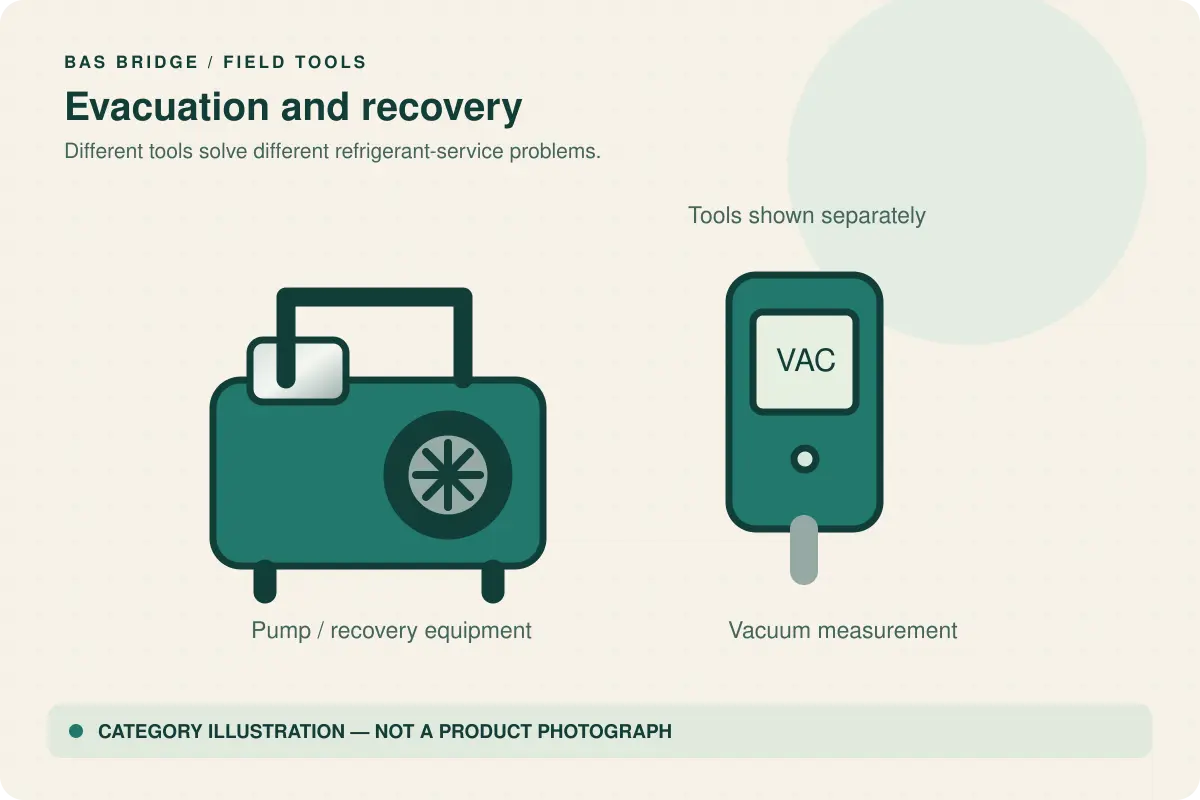
The NRP8Di is a vacuum pump. That distinction matters because a recovery machine and an evacuation pump solve different problems. A recovery machine removes refrigerant into an appropriate recovery arrangement; a vacuum pump is used for the later evacuation stage under the applicable service procedure. The similar appearance of service equipment is a poor reason to treat those jobs as interchangeable.
NAVAC documents this exact model as an 8 CFM smart vacuum pump, with a brushless DC motor, digital vacuum display and a stated 15-micron ultimate vacuum. Those are useful purchase facts. They are manufacturer specifications, rather than results from our own evacuation or endurance tests. This review does not establish that the pump will bring a particular installation to a particular vacuum within a promised time.
What the 8 CFM number helps you decide
Capacity belongs in a comparison of otherwise suitable pumps, but it is only one part of the evacuation path. A hose, valve, fitting or remaining restriction between the pump and system can limit how much of that nominal pumping capacity is useful. Buying more pump before examining that path may leave the original bottleneck in place.
For a buying decision, list the systems you actually service and the connection arrangements your procedures permit. Then assess whether the NRP8Di can be connected with appropriate hoses and fittings without an awkward collection of adapters. Its listed inlet sizes are relevant here: they provide options, not a guarantee that every hose in the van is vacuum suitable or that every port can be used simultaneously in your arrangement.
Read the integrated display in its location
A display on the pump can be convenient when setting up and observing the equipment. The limitation is location. While gas is moving through restrictions, pressure near the pump and pressure farther into the system need not be identical. A low number at the pump therefore deserves a different interpretation from a stabilized reading at a suitable system-side location.
Our preference is to plan the final measurement before choosing a pump. If the procedure calls for an independent micron gauge, a stabilization period or an isolated test, the integrated display does not remove those requirements. The NRP8Di can still be attractive; the useful benefit is accessible pump-side information, rather than an excuse to omit a required acceptance check.
Ultimate vacuum is not a system guarantee
The advertised 15-micron ultimate vacuum describes a pump capability under the manufacturer's conditions. It does not mean a wet, leaking or poorly connected field system will reach that value. It also does not establish an appropriate target for every piece of equipment. Use the equipment manufacturer's evacuation and acceptance criteria.
Consider two disappointing jobs. One arrangement has a leak at a connection; another has a long restrictive evacuation path. A larger pump specification does not identify which problem is present. The more useful purchase is the one that fits a controlled diagnostic arrangement, with suitable isolation and measurement, rather than the one whose final number looks smallest on a catalog page.
Ownership includes more than the pump
Budget for the correct oil, replacement oil, protected storage, suitable hoses, fittings and a way to keep connections clean. Those items influence whether a pump is ready for work when needed. We have not verified current prices for them or measured oil consumption in different service conditions, so there is no credible all-in annual cost figure in this review.
Also check the power requirement and plug configuration for the exact regional unit before ordering. A brushless DC motor describes the motor technology; it is not evidence that this pump is a cordless model. Confirm the manufacturer's current instructions and the actual nameplate rather than inferring the supply arrangement from the word “DC.”
Compare complete workflows, not isolated labels
The Appion TEZ8 is another corded 8 CFM candidate with a different oil-service approach. Comparing the oil system, service support, carrying arrangement and included fittings is more useful than declaring the two pumps equivalent from capacity alone. We have not conducted a side-by-side speed or durability test.
The NAVAC NP4DLM addresses a different constraint: cordless access. If power access repeatedly complicates your work, that may be worth accepting a different capacity and battery-management routine. If reliable power is normally available, cordless convenience may solve a problem you rarely have. Choose the constraint first, then compare the machine.
Before ordering the NRP8Di
Match the model suffix, supply version, included accessories and seller support route. Ask what happens if the display or pump needs service and whether consumables are locally available. A marketplace title alone does not establish authorized-dealer status or warranty eligibility.
The NRP8Di earns consideration when a capable corded pump, flexible connections and a local digital view all fit your regular work. Its strongest buying case is a well-planned evacuation kit. It is weaker if the proposed upgrade consists only of replacing an existing pump without finding why the current evacuation arrangement disappoints.
Reasons to consider it
- Manufacturer-listed 8 CFM capacity and brushless DC motor.
- Integrated digital vacuum display provides a convenient local observation.
- Listed 1/4-, 3/8- and 1/2-inch inlet options support several connection arrangements.
Tradeoffs to consider
- Pump-mounted pressure is not automatically representative of the whole system.
- Corded power, clean oil, suitable hoses and independent verification remain part of the job.
- No timed evacuation, field accuracy or long-term reliability comparison was performed.
Manufacturer specification reference
NAVAC · NRP8Di · NAVAC NRP8Di Smart Vacuum Pump
These are manufacturer specifications, not independently measured results.
- Nominal pumping capacity
- 8 CFM
- Stated ultimate vacuum
- 15 microns; manufacturer claim
- Motor
- Brushless DC motor
- Display
- Built-in digital vacuum display
- Listed inlet sizes
- 1/4, 3/8 and 1/2 inch
Related BAS Bridge learning
Sources & verification
Follow the current manufacturer instructions for your exact model. Specifications and source revisions can change.
Editorial context
Independently written BAS Bridge research review. Manufacturer features are distinguished from editorial judgments. No firsthand use or measured comparative performance is claimed. Amazon customer reviews and star ratings are not copied or synthesized into ratings.
The linked official product documentation was checked on November 2, 2026. This article combines documented features with original task-based analysis. No physical testing, service-call use, Amazon customer-review consensus or independent performance measurement is claimed.
No current price, stock level, customer star rating, or measured reliability rate is implied.
Methodology & disclosure →