Quick verdict
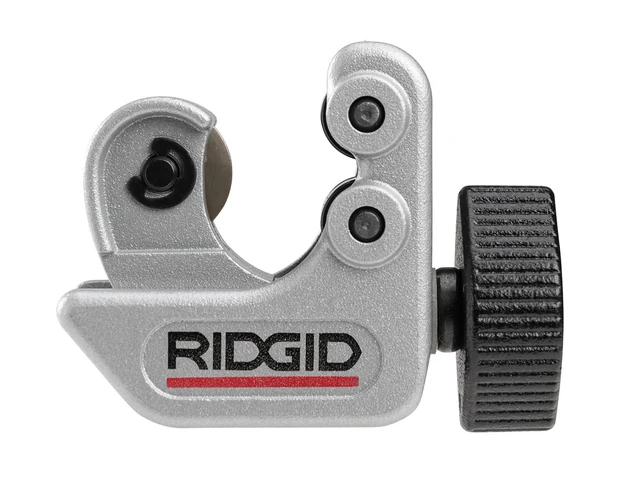
The RIDGID 101, catalog 40617, is a manually fed close-quarters tubing cutter for the documented 1/4–1-1/8-inch outside-diameter range. It earns consideration when a larger cutter cannot turn around the tubing. Check the full operating clearance as well as tube size; this model does not use AUTOFEED.
This is a research-based review. We checked manufacturer specifications, parts documentation, and warranty terms. We have not made test cuts or evaluated cutting effort, finish, or long-term wear.
Pros supported by the design
- Covers a useful range of small tubing diameters.
- Grooved rollers accommodate cuts near a flare.
- Manufacturer parts documentation identifies service components.
Limitations to consider
- Requires physical room around the tubing to operate.
- Manual feed differs from the AUTOFEED models in the same family.
- A compact grip can be less convenient than a larger tool when space is unrestricted.
RIDGID 101 / 40617 capacity and manual feed
RIDGID lists the 101/40617 for tubing from 1/4 to 1-1/8 inches, measured by outside diameter. Its published standard cutting wheel is E-3469. The close-quarters family is described for hard and soft copper, aluminum, brass, and plastic tubing. The 101-ML is a different model for multilayer tubing; similar naming should not obscure that distinction. RIDGID model and capacity table.
RIDGID also distinguishes the manually fed 101 from the 117 and 118 AUTOFEED versions. Do not assume the word “compact” means all three operate the same way. Confirm the exact model before comparing prices or interpreting customer comments about another version.
Where the compact design helps
The purchase makes the most sense when your current cutter’s body or handle is the obstacle. Consider your recurring work: connections tucked near cabinets, tubing alongside another line, or short sections where a conventional handle interferes with surrounding parts. The useful question is whether a smaller assembly creates a workable approach.
Diameter capacity is only one part of that question. You also need room to get the tool onto the tubing, rotate it, reach the feed control, and remove it afterward. A cutter does not gain unlimited clearance because it is called close-quarters. We would check the actual space before treating it as the solution to a specific inaccessible cut.
For a bag assembled around varied service calls, a compact cutter can complement a larger cutter rather than replace it. Keeping both may be justified when each solves a recurring access problem. If most of your cuts are on open tubing at a workbench, the reason for choosing a small body is weaker.
Feed control and cut quality
RIDGID describes a large knurled feed-screw knob and a lightweight slide and wheel housing. Those features explain how the design supports control. They do not establish that every user can turn it comfortably with gloves or that it will produce a better cut than another tool. RIDGID design details.
When evaluating a cutter, separate access from the quality of the result. A tool that fits a space still needs to be appropriate for the tubing and leave an end suitable for the next operation. No cut-time comparison, out-of-round measurement, or flare-preparation result is claimed in this review.
This distinction keeps the buying decision grounded. If your existing cutter already provides good results but cannot physically turn in one recurring location, a smaller cutter addresses that limitation. If the concern is poor cut finish in open space, inspect the condition and suitability of the existing tool before assuming size is the cure.
Parts, wear, and ownership cost
The manufacturer’s parts list for the 101 identifies the E3469 wheel as catalog number 33185, along with a wheel pin and clip, rollers, feed screw, knob, and other components. The diagram also shows a spare wheel. Order by the parts catalog number and match the exact model rather than treating an illustration’s reference number as the order code. RIDGID parts list.
Documented parts support is useful, but it is not a live stock guarantee. Check the cost and availability of the wheel and any required service parts before comparing the long-term value of two cutters. We have not verified current replacement-part prices.
RIDGID’s full lifetime warranty covers defects in material or workmanship and excludes misuse, abuse, and ordinary wear. It should not be read as a promise of unlimited free replacement for worn cutting components. RIDGID warranty terms.
RIDGID 101 vs 117 and 118 AUTOFEED cutters
Compare an AUTOFEED model if reducing repeated feed adjustment is the feature you want, and a conventional larger cutter if open-space grip and leverage matter more. The same manufacturer’s ordering table is a useful starting point for capacity and operating-design differences. It does not establish which feels better in your hands.
For a first service kit, plan this alongside the other tasks your tools must cover. Buy for a real access need and the tubing sizes you encounter. The RIDGID 101 is a sensible candidate for compact work within its documented range, provided its full operating clearance fits the job. Long-term durability and comparative cut quality remain untested here.
Manufacturer specification reference
RIDGID · 101 / 40617 · Model 101 Close Quarters Tubing Cutter
These are manufacturer specifications, not independently measured results.
- Model/catalog number
- 101 / 40617
- Tube outside diameter
- 1/4 to 1-1/8 inches (6–28 mm)
- Standard wheel
- E-3469, replacement catalog 33185
- Feed
- Manual; not AUTOFEED
- Application
- Hard/soft copper, aluminum, brass, plastic tubing
- Warranty
- Defects in material/workmanship; normal wear excluded
Related BAS Bridge learning
Sources & verification
Follow the current manufacturer instructions for your exact model. Specifications and source revisions can change.
- RIDGID close quarters tubing cutter specifications ↗
Official documentation consulted for the documented capabilities and limitations. The article distinguishes source specifications from editorial interpretation.
Checked Oct 29, 2026 · Source publication date: Unknown - RIDGID close quarters tubing cutter parts list ↗
Official documentation consulted for the documented capabilities and limitations. The article distinguishes source specifications from editorial interpretation.
Checked Oct 29, 2026 · Source publication date: Unknown - RIDGID full lifetime warranty terms ↗
Official documentation consulted for the documented capabilities and limitations. The article distinguishes source specifications from editorial interpretation.
Checked Oct 29, 2026 · Source publication date: Unknown - RIDGID 101 / 40617 official product image ↗
Exact-model image linked from the manufacturer product page and visually checked for product identification. The image is not evidence of BAS Bridge ownership or testing.
Checked Oct 29, 2026 · Source publication date: Unknown
Editorial context
Published by BAS Bridge from linked manufacturer documentation and original buying analysis. The review does not claim firsthand experience or independent performance measurements.
Manufacturer product information and operator documentation were checked on October 29, 2026. Practical buying conclusions are editorial analysis; no physical testing or service-call experience is claimed.
No current price, stock level, customer star rating, or measured reliability rate is implied.
Methodology & disclosure →