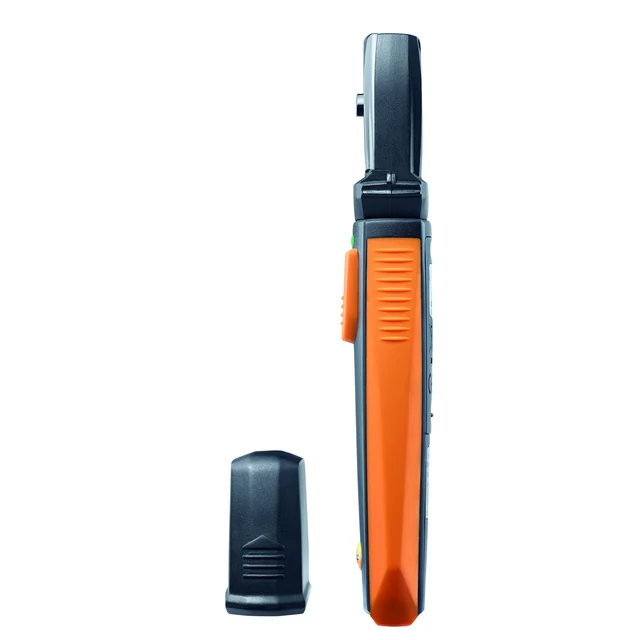
Quick verdict
The Testo 410i is a phone-based vane anemometer for accessible air-velocity and temperature measurements. Its buying appeal is a compact head and connected records; its main limitation is that calculated airflow still depends on representative sampling and the area entered into the app.
What this review establishes
This is documentation-based research checked on October 29, 2026. We have not measured the 410i's accuracy, tested wireless reception or balanced a system with it. The practical recommendations are editorial analysis rather than reports of physical use.
Documented measurement scope
The Testo product page describes the outlet applications and connected workflow. The Smart Probes manual provides the measurement conditions and specifications below.
| Item | Documented specification |
|---|---|
| Vane diameter | 30 mm |
| Velocity range | 0.4 to 30 m/s |
| Specified velocity accuracy | ±(0.2 m/s + 2% of reading), 0.4–20 m/s, ±1 digit per manual |
| Temperature range | −20 to 60 °C |
| Manual velocity resolution | 0.1 m/s; 1 fpm |
| Power | Three AAA batteries |
The specified velocity-accuracy expression stops at 20 m/s even though the measurement range extends to 30 m/s. Do not extend that expression across the entire display range. The manual also gives 1 fpm resolution, while the US page shows 0.1 fpm; the metric resolution agrees at 0.1 m/s.
Those details are more useful than simply comparing the largest number on two product pages. Match your expected measurement range to the part of the specification that actually applies, and check the documentation supplied with the unit you receive.
Calculated CFM depends on area and sampling
A compact vane is attractive when the space you can access is limited. The corresponding question is whether that location represents the airflow you need to report. An outlet with uneven velocity needs a deliberate sampling plan, not just an easy place to hold the probe.
For a simple illustration, calculated volume flow is average velocity multiplied by the applicable area. If velocity is 2 m/s and area is 0.05 m², the result is 0.10 m³/s: 360 m³/h, or approximately 212 cubic feet per minute (CFM). This arithmetic is not a tested 410i reading or an approved procedure for every grille.
If the area used is wrong, a polished volume-flow result can still be wrong. Identify which dimensions and effective-area information the measurement method requires. A grille's outside dimensions should not automatically be assumed to equal the relevant open area for every application.
Averaging supports a plan
Testo describes timed and multipoint averaging in the product information. That can help organize a repeatable observation. Decide the locations and duration before collecting readings so that a convenient number does not drive the method afterward.
Record the outlet, system state, probe orientation, area basis and averaging approach with the result. Repeat the same arrangement when comparing a before-and-after condition. Otherwise a change in fan setting or sampling location may be mistaken for an improvement caused by the work.
The manual identifies a flow-direction arrow on the housing. That is a practical reason to check orientation as part of setup. It does not eliminate the need to consider turbulence, access or the representativeness of the chosen measurement location.
The phone is part of the tool
The 410i's connected format should fit the way you work. Before purchase, verify that your actual phone can install the current Testo app and connect to the intended instrument. An operating-system minimum printed on a product page is not a lifetime promise of app compatibility.
Consider gloves, screen visibility, phone storage and how reports reach the job record. A technician who prefers a local display may find that a separate instrument format better matches daily work. A technician already documenting readings on a phone may value fewer manual transcription steps.
We have not timed report creation or tested the app on specific phones. Treat potential convenience as something to assess against your own reporting process. A successful connection in one location also does not establish reception through every equipment room or building partition.
When another method deserves comparison
For a measurement where a hood, a larger vane or a duct traverse is the appropriate method, compare that complete method before choosing a pocket probe. The lowest initial tool price is not necessarily the lowest cost of producing a defensible result.
This does not make a small vane unhelpful. A clearly described local observation may answer a useful service question. The problem arises when the conclusion is broader than the measurement. State whether you observed one location, averaged an outlet or completed a specified balance procedure.
Ownership and buying checklist
- Confirm the exact 410i and supplied protective cap, batteries and documentation.
- Check current app compatibility on the phone you will carry.
- Include a case and the accessories required by your measurement method.
- Ask about service and calibration support when formal measurement records are required.
Current prices have not been verified. Keep the vane protected in transit and follow the manufacturer's care instructions. We have no evidence here for a particular replacement interval or an independently measured battery runtime.
The 410i is a sensible candidate when portable outlet observations and connected records meet a recurring need. Its value depends on choosing a representative measurement and retaining enough context to interpret it. The app's calculated result should be the end of that process, not a substitute for it.
Manufacturer specification reference
Testo · 410i / 0560 1410 · 410i Wireless Vane Anemometer
These are manufacturer specifications, not independently measured results.
- Vane diameter
- 30 mm
- Velocity range
- 0.4 to 30 m/s
- Specified velocity accuracy
- ±(0.2 m/s + 2% of reading), 0.4–20 m/s, ±1 digit per manual
- Temperature range
- −20 to 60 °C
- Manual velocity resolution
- 0.1 m/s; 1 fpm
- Power
- Three AAA batteries
Related BAS Bridge learning
Sources & verification
Follow the current manufacturer instructions for your exact model. Specifications and source revisions can change.
- Testo 410i US product page ↗
Exact 410i identity, intended outlet applications, app-based readings and reporting, metric ranges and vane diameter. The article distinguishes measurement from derived volume flow.
Checked Oct 29, 2026 · Source publication date: Unknown - Testo Smart Probes instruction manual ↗
410i specifications, accuracy range and digit conditions, flow-direction arrow and instrument/app workflow. The manual gives 1 fpm resolution while the product page shows 0.1 fpm.
Checked Oct 29, 2026 · Source publication date: Unknown - Testo 410i / 0560 1410 official product image ↗
Exact-model image linked from the manufacturer product page and visually checked for product identification. The image is not evidence of BAS Bridge ownership or testing.
Checked Oct 29, 2026 · Source publication date: Unknown
Editorial context
BAS Bridge editorial prepared this documentation-based research overview and buying analysis. No firsthand experience, physical measurement or independent performance test is claimed.
Manufacturer documentation checked on October 29, 2026. Buying recommendations are original editorial interpretation of that documentation, with no physical product testing.
No current price, stock level, customer star rating, or measured reliability rate is implied.
Methodology & disclosure →