Quick verdict
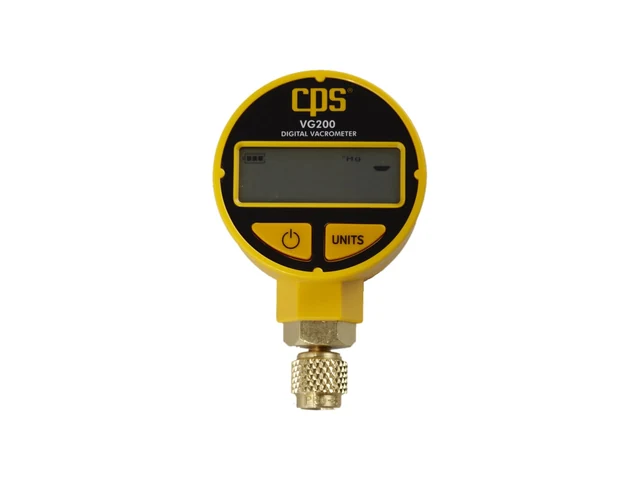
The CPS VG200 suits technicians who want a standalone micron gauge with a local display and two-button controls. It does not provide the VG200W wireless workflow. Before buying, confirm the supplied revision because official documents disagree on pressure limits, battery runtime, and automatic shutoff.
Reasons to consider it: Standalone operation, two-button controls, selectable units, a cleanable sensor, and a supplied fitting and case.
Reasons to choose something else: No wireless view; display access can be awkward; sensor and seal condition remain part of ownership; pressure-rating and runtime documentation need revision confirmation.
This is a research-based CPS VG200 review using official product information, the linked manual and product sheet, and analysis of their implications. We have not checked a physical unit, performed an accuracy comparison, or assessed long-term reliability.
CPS VG200 vs VG200W: which model has wireless?
This review covers the VG200, not the separate VG200W wireless model. The similar names matter when shopping: a listing for one does not prove that the other has the same electronics, features, or package.
The CPS VG200 product page describes a five-digit LCD, two-button operation, selectable microns, Torr, millibar, and inches of mercury, and automatic temperature compensation. It lists a hanging hook, T-fitting, and padded case. The standard model does not provide the wireless workflow advertised for the VG200W.
For a buyer, simple controls can be a positive reason to choose a tool. You may prefer an instrument that does one job and can be handed to another technician without explaining an app. That preference is legitimate, but it should be weighed against where the gauge will be mounted and how often you must look at it.
We would not buy the VG200 expecting remote alerts or phone records to appear later through a software setting. Decide whether local viewing fits the work before ordering.
Measurement specifications: read the fine print
The CPS product sheet specifies ±10% of reading, a 1/4-inch female SAE connection with core depressor, and a self-heated thermistor sensor. Its compensation range is 0–50°C. These are supplied specifications, not results from our testing.
At an indicated 500 microns, 10% is 50 microns. That arithmetic illustrates the accuracy statement; it does not include every source of uncertainty in a real test arrangement. Displaying five digits also does not mean that every displayed digit is an independently accurate measurement.
The Rev.D manual explains that the gauge uses bars at higher pressures and a numerical display from 25,000 microns downward. Its reference to monitoring from atmosphere should therefore not be interpreted as a continuous numerical micron reading over the entire range.
That distinction helps prevent a poor first impression. A buyer expecting a numerical reading immediately after connecting may interpret the bars incorrectly. Read the startup and display section before deciding a new gauge is malfunctioning.
Consider range, resolution, and the test arrangement together. The useful specification is the one that matches the work you need to document, rather than the largest range printed on a page.
VG200 pressure limits and runtime: why the documents disagree
CPS currently links two documents that disagree. The Rev.D manual lists a 600 psig maximum working pressure, 20-hour battery life, and five-minute automatic shutoff. The LTVG11 sheet lists 400 psig, 25 hours, and ten minutes respectively.
We could not establish which revision corresponds to every unit offered on Amazon. Do not use the higher pressure figure as permission to leave a vacuum gauge connected during a pressure test. Confirm the supplied unit’s applicable instructions with CPS and plan a suitable isolation arrangement. This review does not recommend a positive-pressure test limit for the VG200.
The runtime difference is less consequential, but still worth resolving. Do not schedule work on the assumption that either published battery figure is guaranteed. Ask for the instructions that match the product being supplied, particularly if long unattended display periods are central to your buying decision.
This disagreement is a documentation limitation. It is not evidence that the gauge fails to measure vacuum, and it should not be concealed to make a recommendation sound cleaner.
Everyday use: access may matter more than extra features
A gauge can be easy to operate on a bench and inconvenient once installed. Before buying, picture the connection on the equipment you commonly service. Can you see the display without putting your head behind piping? Can the fitting be supported without strain? Is there enough room to connect it without an unnecessary chain of adapters?
The supplied T-fitting gives connection options, but every additional joint should have a reason to be there. Select the arrangement for the measurement you need, rather than building around whichever fitting happens to be easiest to reach.
Display readability remains untested here. We cannot confirm the contrast in bright sunlight, the viewing angle under a condenser, or whether the unit indicator is clear to a particular technician. Those are reasonable purchase checks, especially when eyesight, gloves, or working posture affects how the tool will be used.
Automatic shutoff deserves similar attention. A power-saving feature can be welcome in storage and frustrating during a long observation. Confirm the behavior of the supplied revision before committing to a workflow that depends on continuous viewing.
For a crew sharing instruments, consider how readings will be recorded. A local display may be sufficient when a written record is already standard practice. If a supervisor needs a remote view or repeated time-stamped records, a different instrument may fit more naturally. Do not spend money on simple controls and then add an awkward workaround for a missing function you use daily.
Maintenance and the real cost of ownership
The manual provides a sensor-cleaning procedure using denatured alcohol, calls for air drying, and identifies replacement gaskets as CPS HXG. Consult the complete procedure before cleaning; do not substitute a method intended for a different gauge.
For buying purposes, that means maintenance supplies and replacement seals belong in the comparison. We have not verified their current prices. Check availability, the service contact, turnaround arrangements, and what proof of purchase is needed. A modest purchase-price difference matters less if the instrument cannot be supported when it is needed.
Build a routine that separates the tool from contamination and makes condition changes easier to notice. If a gauge starts behaving differently, record the conditions before changing several things at once. A clear record is more useful to the service provider than a conclusion based solely on the most recent reading.
Do not assume that two gauges disagreeing proves which one is wrong. A useful comparison needs appropriate conditions and a trustworthy reference. Without that, a second number can add doubt instead of resolving it.
VG200 alternatives and the buying decision
If you need remote monitoring, compare a model designed for it. The Fieldpiece MG44 offers local and remote viewing; our MG44 review discusses that workflow and its limits. CPS also markets the distinct VG200W. We have not performed a controlled head-to-head test or established that either alternative is more reliable.
If you mostly stand beside the equipment and want a dedicated local reading, wireless features may add little. In that case, the VG200 remains a reasonable candidate once its revision, display behavior, and support route are confirmed.
Inspect the exact Amazon offer for model, condition, package contents, seller, returns, and warranty terms. A shared product page and an affiliate destination do not verify every offer that can appear there.
The VG200’s case is strongest when straightforward local measurement fits your work. Its documentation differences should be resolved before relying on the affected limits. Choose it because its actual workflow suits the job, with enough budget and time for proper care and verification.
Manufacturer specification reference
CPS · VG200 · VG200 Digital Vacuum Gauge
These are manufacturer specifications, not independently measured results.
- Viewing
- Standalone 5-digit LCD and two-button controls; distinct from VG200W
- Units
- Microns, Torr, millibar, inchesHg
- Numerical micron display
- 25,000 microns downward; bars at higher pressures per manual
- Specified accuracy
- ±10% of reading
- Temperature compensation
- 0–50°C
- Connection
- 1/4-inch female SAE with core depressor
- Power
- 9V alkaline
- Replacement gasket
- CPS HXG
Related BAS Bridge learning
Sources & verification
Follow the current manufacturer instructions for your exact model. Specifications and source revisions can change.
- CPS VG200 official product information ↗
Official documentation consulted for the documented capabilities and limitations. The article distinguishes source specifications from editorial interpretation.
Checked Oct 29, 2026 · Source publication date: Unknown - CPS VG200 owner manual, 73-170 Rev.D ↗
Official documentation consulted for the documented capabilities and limitations. The article distinguishes source specifications from editorial interpretation.
Checked Oct 29, 2026 · Source publication date: Unknown - CPS electronic vacuum gauges product sheet, LTVG11 ↗
Official documentation consulted for the documented capabilities and limitations. The article distinguishes source specifications from editorial interpretation.
Checked Oct 29, 2026 · Source publication date: Unknown - CPS VG200W official product information ↗
Official documentation consulted for the documented capabilities and limitations. The article distinguishes source specifications from editorial interpretation.
Checked Oct 29, 2026 · Source publication date: Unknown - Fieldpiece MG44 official product information ↗
Official documentation consulted for the documented capabilities and limitations. The article distinguishes source specifications from editorial interpretation.
Checked Oct 29, 2026 · Source publication date: Unknown - CPS VG200 official product image ↗
Exact-model image linked from the manufacturer product page and visually checked for product identification. The image is not evidence of BAS Bridge ownership or testing.
Checked Oct 29, 2026 · Source publication date: Unknown
Editorial context
Published by BAS Bridge from linked manufacturer documentation and original buying analysis. The review does not claim firsthand experience or independent performance measurements.
Manufacturer product information and operator documentation were checked on October 29, 2026. Practical buying conclusions are editorial analysis; no physical testing or service-call experience is claimed.
No current price, stock level, customer star rating, or measured reliability rate is implied.
Methodology & disclosure →