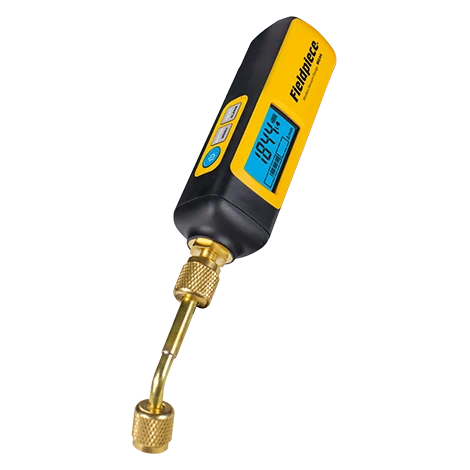
Quick verdict
The Fieldpiece MG44 suits technicians who want a standalone micron-gauge display and optional remote monitoring through Job Link or a compatible SMAN. Its buying advantage is flexible viewing at the system; it does not replace correct gauge placement, clean seals, or an equipment-specific evacuation procedure.
The tradeoff is that wireless monitoring adds setup and a device dependency without removing the need to verify the evacuation arrangement. A convenient display cannot compensate for a leaking connection or tell you where a problem originates by itself.
Reasons to consider it: Local display plus Job Link monitoring; a reversible angled coupler; numerical and graphical views; useful integration for an existing Fieldpiece kit.
Reasons to pause: Real reception depends on the site; gaskets and the sensor require attention; menu preferences need setup; purchase support depends on the seller. We have not field-tested it.
This research-based Fieldpiece MG44 review uses official documentation and analysis of its stated capabilities. We did not measure vacuum accuracy, leak tightness, wireless range, drop resistance, or long-term service life.
The specifications that affect the decision
These are selected manufacturer specifications, with their stated limits:
| Item | MG44 specification |
|---|---|
| Numerical vacuum range | 50–25,000 microns |
| Specified accuracy | ±(5% of reading + 5 microns), from 50–2,000 microns at 25°C |
| Best numerical resolution | 1 micron below 2,000 microns |
| Connection | 1/4-inch SAE male fitting with reversible angled coupler |
| Viewing options | Gauge display, Job Link app, or compatible SMAN display |
| Wireless range claim | Up to 1,000 feet in line of sight; obstructions reduce distance |
| Weather protection | IP54; do not read this as permission to immerse the gauge |
Accuracy and resolution are different. A display changing in one-micron steps does not mean the true pressure is known within one micron. At an indicated 500 microns, the stated accuracy formula gives ±30 microns under the specified conditions: 5% of 500 is 25, plus 5. That is a calculation from the specification, not a measurement of an MG44.
For buying purposes, concentrate on whether the range and stated accuracy suit the acceptance criteria for your work. A larger display number or a smaller final digit has little value if the measurement arrangement is poorly controlled.
Does the MG44 work without a phone?
A remote view can be useful when the gauge is mounted somewhere awkward or when another part of the same job needs attention nearby. Its value is access to the reading, rather than a guarantee that an evacuation finishes sooner. We cannot attach a time-saving figure to that convenience without a timed comparison.
Decide how often remote monitoring solves a real problem. If the gauge usually sits beside you, connectivity may be a small benefit. If your work repeatedly makes the local display difficult to see, it may justify more of the purchase cost. This is particularly relevant if the phone already forms part of your normal diagnostic record.
The advertised range needs context. Steel equipment, walls, distance, phone position, and the working environment can make a line-of-sight number a poor predictor of the connection you will get on a specific job. Check reception in the actual arrangement before relying on a distant display. Wireless visibility also does not transfer responsibility for attending equipment safely.
An app is another item to keep ready: compatible phone, sufficient charge, suitable permissions, and a working connection. If your company restricts personal phones or you prefer to keep one away from dirty work, include that constraint in the decision. The MG44’s independent display is useful in that conversation because remote viewing can remain optional.
Evacuation readings: what the gauge can and cannot establish
The MG44 manual recommends connecting directly to the system rather than through a hose. It explains that a running pump creates a pressure gradient and that the system should stabilize after the pump is isolated before the reading is treated as representative of the whole system. The practical implication is that gauge location belongs in the measurement record.
A micron value is an observation at a particular location and time. It is not a diagnosis on its own. If a result disappoints, the decision should be about what observation will distinguish the possibilities, rather than which component to blame first. Compare the gauge connection, evacuation equipment, test arrangement, and system conditions in a controlled sequence.
The same reasoning applies when comparing two gauges. Readings taken at different ports, at different times, or while flow is changing are not automatically an accuracy comparison. If confidence in a gauge is important enough to influence releasing a system, seek a suitable reference or a qualified service check instead of declaring one instrument correct because its number looks more reassuring.
We have not validated a universal evacuation target for every system. Follow the equipment manufacturer’s procedure and criteria. A review should help choose the measuring instrument without inventing a one-number rule for the equipment being serviced.
Sensor care, seals, and ownership
The manual describes sensor cleaning, coupler-gasket replacement, and hand tightening to protect seals. It also warns to disconnect the MG44 before applying system pressure. Read the complete instructions for those tasks rather than treating the gauge as a fit-and-forget accessory.
For ownership cost, price the consumables and support route before comparing instrument prices. We have not verified current costs for replacement seals, couplers, or service. Ask who supplies them, whether replacements are easy to obtain, and what happens if the instrument needs assessment during a busy period.
Keep a small place in the bag for clean, protected fittings. A tool that spends its working life next to oil and dirty hoses benefits from a storage routine that makes contamination easier to notice. That is a practical ownership consideration, not a claim that this gauge needs more maintenance than its competitors.
There is one documentation difference worth preserving: the current product page lists 40 hours of typical battery life, while the linked v07 manual lists 50. Both specify two AA alkaline batteries. We have not resolved the revision difference or measured runtime, so do not plan work around either figure as a guarantee.
Fieldpiece MG44 vs CPS VG200: wireless or local viewing?
If remote viewing would rarely be used, a simpler gauge may be enough. The CPS VG200 uses a local display and two-button controls. The real choice is whether you want that simpler workflow or the MG44’s additional viewing options. We have not performed a controlled accuracy or reliability comparison between them.
Our CPS VG200 review explains its own limits and documentation questions. Compare range, stated accuracy, sensor maintenance, and the test arrangement alongside your existing kit: a phone-based workflow may be attractive in one service business and unnecessary in another.
Buying the MG44 on Amazon
Check the exact model, included coupler, condition, seller, returns, and warranty route. Fieldpiece’s marketplace policy requires written authorization for marketplace selling. Its manual describes the limited warranty for authorized-dealer purchases. We have not confirmed every seller that can appear on this listing; verify authorization with Fieldpiece when choosing an offer.
The MG44 is a reasonable candidate when local and remote viewing both earn their place in your work. Buy it for that workflow, then verify the setup before relying on the result. Claims of universal leak-free operation, guaranteed reception, or independent accuracy would require evidence this review does not have.
Manufacturer specification reference
Fieldpiece · MG44 · MG44 Wireless Vacuum Gauge
These are manufacturer specifications, not independently measured results.
- Measurement range
- 50–25,000 microns
- Specified accuracy
- ±(5% of reading + 5 microns), 50–2,000 microns at 25°C
- Best resolution
- 1 micron below 2,000 microns
- Connection
- 1/4-inch SAE male; reversible 45-degree coupler
- Display
- Local display, Job Link app, compatible SMAN
- Wireless range
- Up to 1,000 feet line of sight; obstructions reduce range
- Protection rating
- IP54
- Power
- Two AA alkaline batteries
Related BAS Bridge learning
Sources & verification
Follow the current manufacturer instructions for your exact model. Specifications and source revisions can change.
- Fieldpiece MG44 product specifications and FAQs ↗
Official documentation consulted for the documented capabilities and limitations. The article distinguishes source specifications from editorial interpretation.
Checked Oct 29, 2026 · Source publication date: Unknown - Fieldpiece MG44 operator manual v07 ↗
Official documentation consulted for the documented capabilities and limitations. The article distinguishes source specifications from editorial interpretation.
Checked Oct 29, 2026 · Source publication date: Unknown - Fieldpiece online marketplace policy ↗
Official documentation consulted for the documented capabilities and limitations. The article distinguishes source specifications from editorial interpretation.
Checked Oct 29, 2026 · Source publication date: Unknown - CPS VG200 official product information ↗
Official documentation consulted for the documented capabilities and limitations. The article distinguishes source specifications from editorial interpretation.
Checked Oct 29, 2026 · Source publication date: Unknown - Fieldpiece MG44 official product image ↗
Exact-model image linked from the manufacturer product page and visually checked for product identification. The image is not evidence of BAS Bridge ownership or testing.
Checked Oct 29, 2026 · Source publication date: Unknown
Editorial context
Published by BAS Bridge from linked manufacturer documentation and original buying analysis. The review does not claim firsthand experience or independent performance measurements.
Manufacturer product information and operator documentation were checked on October 29, 2026. Practical buying conclusions are editorial analysis; no physical testing or service-call experience is claimed.
No current price, stock level, customer star rating, or measured reliability rate is implied.
Methodology & disclosure →