Quick verdict
The Fieldpiece SM482V suits technicians who want a four-port refrigerant manifold, an integrated vacuum gauge, and a local screen with optional Job Link measurements. Choose around your repair workflow: the standard package includes wired temperature probes, while hoses and additional wireless instruments need their own budget.
The main tradeoff is carrying and maintaining a substantial manifold assembly. If most of your work consists of taking operating readings without transferring refrigerant, consider a wireless probe kit before spending on a four-port manifold.
Reasons to consider it
- A local screen keeps the central readings at the equipment.
- A dedicated vacuum connection suits a manifold-centered workflow.
- Wired temperature probes let you start without buying a wireless kit.
Reasons to look elsewhere
- A full manifold and hoses can be more equipment than a routine diagnostic visit needs.
- The integrated vacuum sensor adds cleaning and connection questions to evacuation work.
- Extra wireless instruments and hoses expand the total purchase.
What this review establishes
This is a research-based buying review, checked October 29, 2026. Manufacturer documentation establishes the functions and operating limits discussed here. The practical recommendations are our interpretation of how those functions fit different kinds of service work. We have not measured this unit’s accuracy, drop resistance, outdoor readability, wireless range, or time savings.
The SM482V should therefore be judged by the tasks you need it to perform, followed by a careful inspection of the actual package and seller. A specification list can support a purchase decision; it cannot establish how a particular unit will behave after several seasons in a service truck.
Exact model, connections, and package
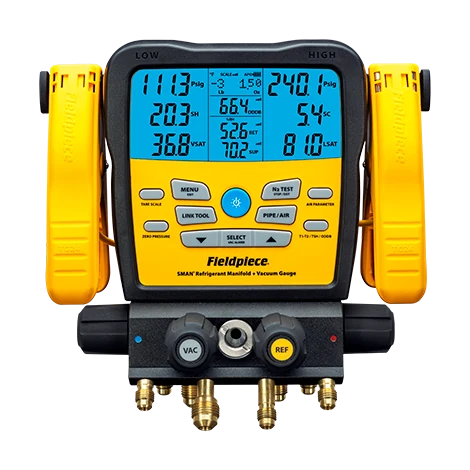
Fieldpiece’s SM482V product page identifies a four-port manifold with three quarter-inch connections and a three-eighths-inch vacuum connection. It lists a five-inch LCD, an integrated micron gauge, wireless connectivity, and USB-C data export and firmware support.
The standard manufacturer’s package includes two TC24 wired pipe clamps, an ATA1 bead thermocouple, an ANC82 padded case, six AA batteries, and the manual. Hoses are not listed in that package. Seller-created bundles need their own check.
| Buying detail | What to check |
|---|---|
| Model | SM482V, including the final V |
| Refrigerant connections | Required hose and equipment fitting sizes |
| Temperature measurement | Included wired clamps versus optional wireless probes |
| Evacuation setup | Vacuum hose, isolation tools, and gauge placement |
| Replacement purchases | Hoses, seals, clamps, batteries, and a backup plan |
Do not choose a bundle solely because the photograph looks complete. Match the written contents to the work you intend to do. A case containing a manifold is a different purchase from a kit containing every hose, adapter, and accessory needed for a specific system.
How the manifold fits everyday diagnosis
The central buying question is whether you want your main information attached to your refrigerant connections. With a manifold, the screen and valve block stay together. That gives you an obvious place to look and an obvious place to return your attention after checking another part of the equipment.
For a technician moving between repair, commissioning, and refrigerant transfer, that consistency has practical appeal. For a technician making many quick condition checks, the same assembly may feel like extra handling. Neither preference makes the other workflow wrong. The useful comparison is your normal call sequence, including carrying the equipment, making the connections, recording the findings, and packing everything away.
Digital calculations also deserve the right expectations. Schneider Electric explains that superheat and subcooling depend on measured temperature and the corresponding saturation condition; refrigerant blends require attention to the appropriate pressure-temperature relationship. Our buying implication is that automatic calculations reduce a clerical step while leaving input quality and interpretation with the technician.
For example, a clearly displayed result is still a weak basis for a decision if you selected the wrong refrigerant or assigned the wrong temperature measurement. When comparing digital manifolds, ask how easily you can confirm those inputs. An interface that makes verification straightforward is worth more than an impressive number of calculations that you rarely use.
Vacuum measurement: the important qualification
The SM482V manual specifies a 50–9,999-micron range and vacuum accuracy of ±(5% of reading + 5 microns) from 50–2,000 microns at 77°F. Those are specified limits, not measurements from this review.
At a hypothetical 500-micron indication, that accuracy expression equals ±30 microns: 0.05 × 500 + 5. This calculation illustrates the stated tolerance under its conditions. It does not prove the pressure everywhere in the connected system, and it does not supply an acceptable evacuation target for your equipment.
Fieldpiece’s vacuum guidance emphasizes the equipment manufacturer’s requirements, restrictions in the connection path, and sensor location. Our interpretation is that an integrated gauge is useful only when the complete setup lets it answer the question you are asking.
Before choosing this manifold for evacuation work, sketch the actual connection path you intend to use. Identify the system, hoses, valves, pump, and sensor. Then check which volume the sensor will still see when the pump is isolated. That small planning step is more valuable than choosing by the lowest number on a display.
A separate Fieldpiece MG44 may make more sense if you want vacuum measurement positioned independently of the manifold. A standalone local-display gauge is another arrangement to compare. This is a placement decision, not a claim that one sensor design wins every evacuation.
SM482V vs a Job Link probe kit: which workflow fits?
The fourth port is worth buying when it supports a connection arrangement you will actually use. It is less persuasive as a feature purchased for an imagined future job. Write down the most common repair requiring your manifold and the most common visit requiring only measurements. Which one consumes more of your week?
If repairs dominate, keeping a manifold ready with a familiar hose arrangement may suit you well. If diagnostic visits dominate, separate probes may deserve priority. If you already own dependable analog gauges, keeping them for transfer work while adding measurement probes is another reasonable staged purchase.
There is also a teamwork question. A local display gives a second technician a shared place to inspect readings. A phone-based workflow can also be shared, but it introduces choices about devices, access, and how the readings are presented. Consider how your shop actually works instead of assuming every technician wants the same screen arrangement.
Display, controls, and wireless use
Fieldpiece advertises an adjustable backlight and up to 1,000 feet of wireless range in line of sight; it explicitly notes that obstructions reduce range. A backlight is evidence of illumination, not proof of direct-sun readability. The maximum wireless distance is not a promise of communication through walls or metal equipment enclosures.
For an outdoor service kit, the most useful personal check would be whether you can read the values while standing where the tool must hang. Gloves, hose routing, reflected light, and the direction you approach the equipment all affect that experience. Those remain untested here.
Our purchasing advice is to treat wireless access as added flexibility while making sure the basic local workflow suits you. If remote viewing is the primary reason you want the manifold, compare that complete arrangement with a probe kit. If remote viewing is only occasional, the built-in display may be the more important feature.
Ownership costs beyond the manifold
Think in terms of a working kit and a service plan. The initial purchase can be followed by hoses, adapters, replacement seals, temperature probes, storage, and batteries. Some items may already be in your truck. Others may duplicate equipment you bought recently. A written inventory makes the comparison much clearer.
Fieldpiece’s Job Link plans distinguish free measurement and reporting functions from paid business features. Check the current feature list against your reporting needs. Do not assume a subscription is required for every wireless reading, or that every recordkeeping feature is included at no additional cost.
The decision should also include downtime. Ask where the unit would go for service and what you would use in the meantime. A tool that is central to your daily workflow deserves a backup arrangement, even when its specification sheet looks reassuring. This review has no repair-history sample from which to estimate expected downtime or lifetime cost.
Buying the SM482V on Amazon
Match the listing to the exact SM482V and check the written bundle contents, seller, condition, and return terms before ordering. A familiar brand name in a listing does not by itself establish who is supplying the product.
Fieldpiece’s marketplace policy says third-party marketplace selling requires its written authorization. The practical step is to confirm the selected seller’s authorization and applicable warranty coverage with Fieldpiece. This does not establish that every Amazon seller is unauthorized; it means the particular offer matters.
Keep the order record and the manufacturer’s documentation together. If a seller offers a different package, compare what you receive against that package rather than against photographs from another offer. Avoid paying for accessories whose identity, compatibility, or necessity is unclear.
Who should buy it?
Consider the SM482V if you perform enough refrigerant-side repair work to justify a four-port manifold, prefer a local screen, and want the option of adding wireless readings over time. It is also a reasonable candidate when your existing manifold needs replacement and you have identified a specific workflow improvement.
Compare other arrangements first if you already own serviceable transfer equipment and mainly need faster access to operating measurements. The JL3KH6 review explains the different compromises of a six-probe kit. The MG44 and VG200 reviews cover the separate question of vacuum measurement.
Before ordering, answer three questions: Which recurring task will this purchase improve? What additional equipment must you buy? What evidence would show that the improvement happened? Those answers give you a more useful buying standard than brand loyalty or the longest feature list.
Common buying questions
Is the SM482V a complete evacuation kit?
The standard manufacturer’s contents do not include every hose and accessory required for a particular installation. Plan the complete setup and check the individual listing. The manifold’s vacuum function does not establish that the rest of your equipment is suitable.
Does A2L compatibility mean it can be used anywhere?
No. The operator manual limits use to qualified personnel and non-hazardous areas and contains specific refrigerant-handling precautions. Compatibility is not permission to disregard the working environment, equipment instructions, or applicable requirements.
Is it worth replacing a working manifold?
Only when its features solve a problem that matters in your work. If the existing kit gives you the information and connection options you need, keep it until you can identify a concrete reason to change. The SM482V is a candidate for a workflow improvement, not an automatic upgrade for every technician.
Manufacturer specification reference
Fieldpiece · SM482V · SM482V 4-Port Wireless Refrigerant Manifold
These are manufacturer specifications, not independently measured results.
- Ports
- Three 1/4-inch SAE male flare ports and one 3/8-inch SAE male flare vacuum port (operator manual)
- Display
- 5-inch LCD with adjustable backlight
- Maximum pressure
- 870 psig maximum manifold pressure
- Vacuum range
- 50–9,999 microns
- Vacuum accuracy
- ±(5% of reading + 5 microns), 50–2,000 microns at 25°C
- Wireless range
- 1,000 feet line of sight; obstructions reduce distance
- Power
- Six AA alkaline batteries
- Included probes
- Two TC24 wired pipe clamps and one ATA1 bead thermocouple
Related BAS Bridge learning
Sources & verification
Follow the current manufacturer instructions for your exact model. Specifications and source revisions can change.
- Fieldpiece SM482V official product specifications ↗
Official documentation consulted for the documented capabilities and limitations. The article distinguishes source specifications from editorial interpretation.
Checked Oct 29, 2026 · Source publication date: Unknown - Fieldpiece SM382V and SM482V operator manual v16 ↗
Official documentation consulted for the documented capabilities and limitations. The article distinguishes source specifications from editorial interpretation.
Checked Oct 29, 2026 · Source publication date: Unknown - Fieldpiece guidance on vacuum-gauge use ↗
Official documentation consulted for the documented capabilities and limitations. The article distinguishes source specifications from editorial interpretation.
Checked Oct 29, 2026 · Source publication date: Unknown - Schneider Electric pressure-temperature chart explanation ↗
Official documentation consulted for the documented capabilities and limitations. The article distinguishes source specifications from editorial interpretation.
Checked Oct 29, 2026 · Source publication date: Unknown - Fieldpiece Job Link system plans and features ↗
Official documentation consulted for the documented capabilities and limitations. The article distinguishes source specifications from editorial interpretation.
Checked Oct 29, 2026 · Source publication date: Unknown - Fieldpiece online marketplace policy ↗
Official documentation consulted for the documented capabilities and limitations. The article distinguishes source specifications from editorial interpretation.
Checked Oct 29, 2026 · Source publication date: Unknown - Fieldpiece SM482V official product image ↗
Exact-model image linked from the manufacturer product page and visually checked for product identification. The image is not evidence of BAS Bridge ownership or testing.
Checked Oct 29, 2026 · Source publication date: Unknown
Editorial context
Published by BAS Bridge from linked manufacturer documentation and original buying analysis. The review does not claim firsthand experience or independent performance measurements.
Manufacturer product information and operator documentation were checked on October 29, 2026. Practical buying conclusions are editorial analysis; no physical testing or service-call experience is claimed.
No current price, stock level, customer star rating, or measured reliability rate is implied.
Methodology & disclosure →