Quick verdict
The JL3RH is useful when you need temperature and humidity information at a duct or grille while observing the rest of the system elsewhere. Its value depends on representative placement and a realistic understanding of what air-side readings prove.
This is a research-based review of the exact model, using the linked official documentation and original buying analysis. We have not performed hands-on or comparative testing. Amazon customer reviews and star ratings are not reproduced or represented as independent evidence.
What the JL3RH adds to a service bag
Temperature split alone can leave an air-conditioning diagnosis incomplete. The JL3RH adds relative humidity and wireless access to the measured air temperature, which makes it a more informative companion for a refrigerant-side assessment. Fieldpiece documents a flexible 9.25-inch wand, a 3/8-inch duct access requirement, a sliding magnetic hanger, and a temperature range of -40°F to 250°F. Those specifications describe the instrument, not the quality of any particular sample.
Its strongest buying case is a job where the technician cannot conveniently watch supply and return conditions while making observations elsewhere. A probe can remain at a representative point while readings are reviewed through Job Link. That arrangement may reduce unnecessary movement, but we have not timed a service call or verified reception through a building.
Representative air matters more than convenience
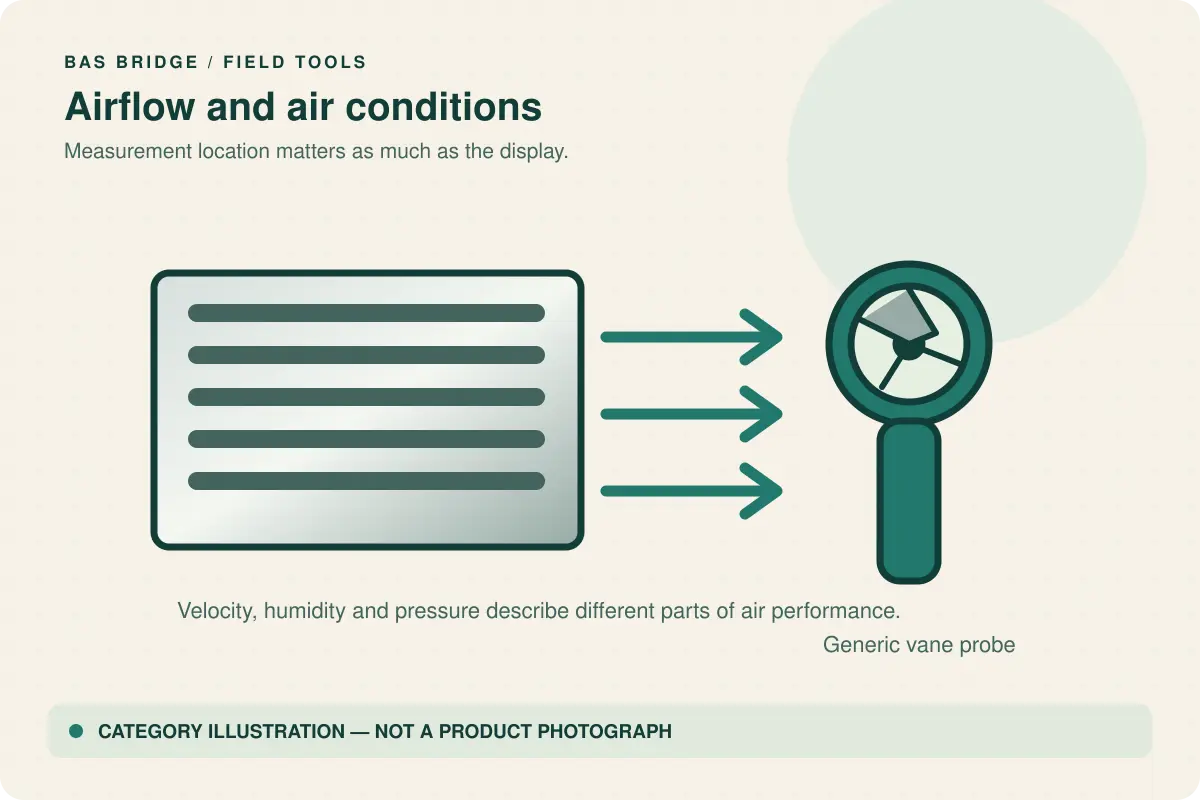
A neat magnetic mounting position is not automatically a useful measuring position. Air can be poorly mixed, influenced by a nearby leak, or different across a plenum. A sample close to an unusual local condition may tell you about that spot rather than the air delivered to the system. The buying benefit is access flexibility; selecting the sampling location remains the technician’s responsibility.
Humidity measurements also need a reasonable opportunity to settle after moving between conditions. A quick dry-bulb response does not prove the humidity sensor has reached equilibrium. In practical terms, establish a stable operating state and look for a stable trend before treating a number as representative. Keep the sensor protected from contamination and conditions outside the manual’s limits.
What the calculated values can and cannot prove
A psychrometric application can derive wet-bulb temperature, dew point, and other useful quantities from measured conditions. These calculated values are only as reliable as their inputs. A capacity estimate adds another major input: credible airflow. A wireless temperature-and-humidity probe does not independently establish how much air is moving through the coil.
For that reason, the JL3RH is best viewed as one part of a measurement chain. Supply and return readings can help interpret sensible and latent behavior, while an airflow investigation determines whether the air quantity is plausible. If a result conflicts with other observations, check placement, sensor condition, stability, and airflow before assuming the equipment needs a charge adjustment.
Choose the probe or the kit deliberately
A single JL3RH can be a useful incremental purchase for someone already in Job Link. For simultaneous supply and return observations, the shopping comparison changes because two probes may be required. Compare that complete arrangement with the existing JL3KH6 kit and with another compatible air-side platform; include protective covers and the way the instruments will be stored.
This is a research review. We have not compared humidity accuracy after repeated wet-coil exposure, checked magnet holding force, or measured stabilization time in a duct. The reason to shortlist the JL3RH is its documented access and integration, coupled with a clear air-side measurement need. Wireless convenience should support a sound sampling method rather than become the method itself.
Does the JL3RH measure airflow?
No. Its role is air temperature and humidity measurement. Airflow or capacity work needs the additional measurements and assumptions appropriate to the method.
Is one probe enough for a temperature split?
One can be moved between locations, but the readings are then taken at different times. Two probes are useful when the aim is to observe supply and return conditions simultaneously under the same operating state.
Reasons to consider it
- Flexible wand and sliding magnet support varied measuring positions
- Measures both temperature and relative humidity
- Wireless viewing can keep air-side conditions visible during adjustments
Tradeoffs to consider
- Placement and stabilization can dominate the usefulness of a reading
- A psychrometer does not directly measure CFM
- No field comparison of response, humidity accuracy, or radio range was performed
- Measuring airflow directly
- Treating a calculated capacity number as a verified result without credible airflow
Manufacturer specification reference
Fieldpiece · JL3RH · Fieldpiece JL3RH Wireless Flex Psychrometer
These are manufacturer specifications, not independently measured results.
- Temperature range
- -40°F to 250°F
- Humidity range
- 0–100% RH
- Probe
- 9.25-inch flexible wand
- Access
- 3/8-inch duct opening
- Power
- Two AAA batteries
Related BAS Bridge learning
Sources & verification
Follow the current manufacturer instructions for your exact model. Specifications and source revisions can change.
- Fieldpiece JL3RH official product information ↗
Official model documentation checked for the features and limits discussed in this original research review. Specifications are manufacturer claims; buying judgments are editorial analysis.
Checked Nov 2, 2026 · Source publication date: Unknown
Editorial context
Independently written BAS Bridge research review. Manufacturer features are distinguished from editorial judgments. No firsthand use or measured comparative performance is claimed. Amazon customer reviews and star ratings are not copied or synthesized into ratings.
The linked official product documentation was checked on November 2, 2026. This article combines documented features with original task-based analysis. No physical testing, service-call use, Amazon customer-review consensus or independent performance measurement is claimed.
No current price, stock level, customer star rating, or measured reliability rate is implied.
Methodology & disclosure →