Quick verdict
The 605i is useful when temperature alone does not explain the air-side condition and an existing Testo workflow can use the added humidity data. Its calculated values depend on representative sampling and the documented accuracy conditions.
This is a research-based review of the exact model, using the linked official documentation and original buying analysis. We have not performed hands-on or comparative testing. Amazon customer reviews and star ratings are not reproduced or represented as independent evidence.
Why humidity changes the diagnosis
Two air streams can share a dry-bulb temperature while differing substantially in moisture content. The 605i addresses that missing information by measuring temperature and relative humidity and using the Smart App to derive wet-bulb temperature and dew point. The current documentation gives a -4°F to 140°F temperature range and 0–100% RH humidity range. The best listed midrange humidity accuracy is ±2% RH at 35–65% RH and 77°F.
That last condition matters. The instrument should not be described as ±2% RH everywhere simply because that is the most attractive number in the table. Read the accuracy band that applies to the expected condition, and remember that an app calculation cannot improve the uncertainty of the underlying measurements.
Put it where the air is representative
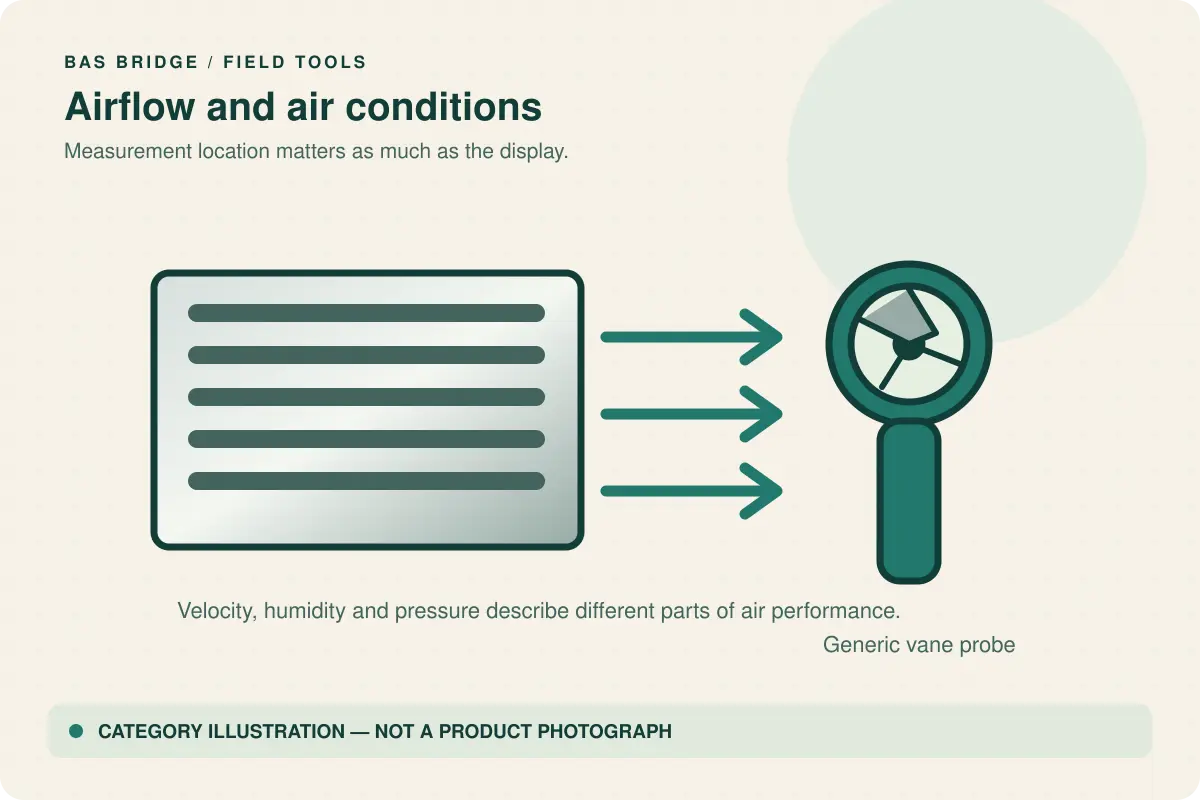
A bendable probe head helps place the sensor, but physical convenience is not the same thing as a good sampling location. A nearby leak, poorly mixed plenum, or local influence can make the reading unrepresentative of the air entering or leaving the coil. The technician needs to decide what air stream the measurement is intended to describe.
Humidity response also deserves patience after moving between different conditions. A changing reading may describe stabilization of the sensor, a changing system, or both. Look for a useful stable trend and follow the manual’s limits and care instructions. Protect the sensing area instead of treating it like a general-purpose probe that can be exposed to any liquid or contamination.
Use the calculations with the right boundaries
Wet-bulb temperature and dew point can help organize an air-side explanation, but they are derived values rather than additional independent sensors. If the temperature or humidity input is wrong, the calculations inherit the problem. Comparing several outputs from the same two inputs is not equivalent to obtaining several independent confirmations.
A capacity calculation also needs credible airflow. The 605i does not directly establish CFM, even when the app presents load-related functions alongside the readings. Combine air conditions with an appropriate airflow method and identify the assumptions. A polished report should make those assumptions easier to inspect rather than make the calculation appear more conclusive than it is.
Single probe, pair, or larger kit?
One 605i is a useful addition for occasional room or duct observations. Two can be more appropriate for simultaneous supply and return comparisons, particularly when the system changes during the visit. Compare that complete cost with the relevant kit and with instruments already owned. Cases and sensor protection are part of keeping a humidity instrument useful.
Our verdict favors the 605i when it closes a clear air-side information gap within a Testo platform. Compare the Fieldpiece JL3RH if choosing a platform from scratch, and an appropriate standalone psychrometer if remote viewing is unnecessary. We have not measured accuracy against a humidity reference, response after contamination, or wireless reception under field conditions.
Does the 605i directly measure wet-bulb temperature?
The documented workflow measures temperature and relative humidity, with the Smart App calculating wet-bulb temperature and dew point.
Can its humidity reading prove cooling capacity?
Not by itself. Capacity work also requires credible airflow and an appropriate calculation method, with the measurement conditions and assumptions identified.
Reasons to consider it
- Measures temperature and relative humidity in one compact probe
- Smart App derives wet-bulb temperature and dew point
- Wireless viewing can join air-side observations with other system data
Tradeoffs to consider
- Humidity accuracy varies with range and reference temperature
- Sampling location and sensor stabilization affect usefulness
- No independent humidity-reference or contamination testing was performed
- Direct airflow measurement
- Assuming the best humidity accuracy applies across the entire range
Manufacturer specification reference
Testo · 605i · Testo 605i Wireless Thermohygrometer
These are manufacturer specifications, not independently measured results.
- Temperature range
- -4°F to 140°F
- Humidity range
- 0–100% RH
- Midrange humidity accuracy
- ±2% RH at 35–65% RH and 77°F
- App calculations
- Dew point and wet-bulb temperature
- Power
- Three AAA batteries
Related BAS Bridge learning
Sources & verification
Follow the current manufacturer instructions for your exact model. Specifications and source revisions can change.
- Testo 605i official product information ↗
Official model documentation checked for the features and limits discussed in this original research review. Specifications are manufacturer claims; buying judgments are editorial analysis.
Checked Nov 2, 2026 · Source publication date: Unknown
Editorial context
Independently written BAS Bridge research review. Manufacturer features are distinguished from editorial judgments. No firsthand use or measured comparative performance is claimed. Amazon customer reviews and star ratings are not copied or synthesized into ratings.
The linked official product documentation was checked on November 2, 2026. This article combines documented features with original task-based analysis. No physical testing, service-call use, Amazon customer-review consensus or independent performance measurement is claimed.
No current price, stock level, customer star rating, or measured reliability rate is implied.
Methodology & disclosure →