Quick verdict
The MR45 deserves consideration for technicians who want a portable recovery machine with variable-speed control and clear pressure feedback. Judge it with the hoses, cylinder, scale, power supply, and refrigerants that will actually be used.
This is a research-based review of the exact model, using the linked official documentation and original buying analysis. We have not performed hands-on or comparative testing. Amazon customer reviews and star ratings are not reproduced or represented as independent evidence.
What the MR45 actually offers
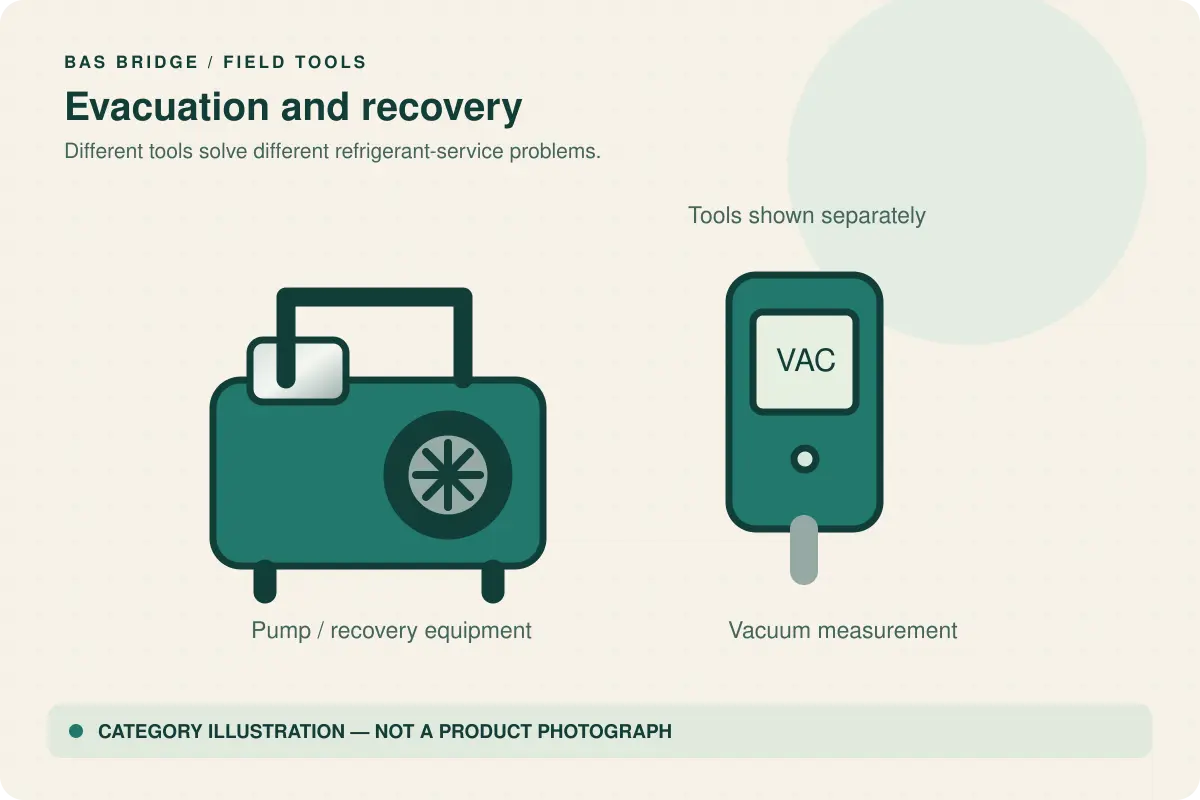
The MR45 is a refrigerant recovery machine, not a substitute for an evacuation pump. Fieldpiece documents a variable-speed 1 HP DC motor, an oil-less twin-cylinder compressor, a 95–130 VAC 60 Hz supply range, self-purge, three selectable auto-stop levels, and a 22 lb weight. Its purpose is to move refrigerant into an appropriate recovery cylinder as part of a controlled recovery procedure.
Those features make it a serious professional candidate, but they do not establish a universal recovery time. The manufacturer’s variable-speed design is one part of the system. Hose paths, restrictions, refrigerant state, ambient conditions, and the cylinder arrangement can all affect the work, so a machine-only comparison leaves important operating variables outside the frame.
A useful comparison includes the entire recovery path
Before selecting a machine, sketch how refrigerant will travel from the equipment to the cylinder. Identify the fittings, restrictions, isolation points, and the measurement that will show how much refrigerant has entered the cylinder. That exercise can reveal a more important purchasing need than a different motor specification.
Cylinder management remains a separate responsibility. Auto-stop relates to the machine’s pressure behavior; it does not replace suitable cylinder selection, fill control, weighing, or a complete refrigerant-handling procedure. The scale and cylinder are part of the working system, even if a shopping listing presents the recovery machine as a self-contained solution.
Power and refrigerant compatibility are exact-model questions
The documented supply range should be treated as an operating limit, not as encouragement to run with a poor extension arrangement or deliberately inadequate supply. Check the current manual for the appropriate power setup. A voltage-compensating feature does not make every cable, outlet, or site condition acceptable.
Fieldpiece identifies A2L compatibility for the current MR45 documentation. Verify the actual unit, documentation, and refrigerants in the intended job; do not generalize from a brand name to every serial revision or to A3 refrigerants. The qualified technician still needs the appropriate handling, ventilation, and work procedures for the refrigerant involved.
Self-purge, support, and the verdict
Self-purge is useful because residual refrigerant in the machine matters at the end of a recovery operation and before subsequent work. The feature belongs within the documented sequence rather than becoming a shortcut around refrigerant identification or contamination control. A machine used across different systems needs disciplined setup and close-out habits.
Compare the MR45 with the Appion G5Twin on exact refrigerant suitability, package contents, service support, transport, and total setup cost. We have not independently tested recovery rates or long-term service life. Shortlist the MR45 when its control features fit your work, then verify the seller, warranty route, and the supporting recovery equipment before treating the purchase as complete.
Can an auto-stop setting prevent cylinder overfill by itself?
No. Machine pressure control and cylinder fill control are different things. The cylinder, scale, and complete recovery procedure must be appropriate for the job.
Does the MR45 replace a vacuum pump?
No. It performs refrigerant recovery. Deep evacuation after recovery and repairs is a separate operation requiring suitable evacuation equipment.
Reasons to consider it
- Variable-speed DC motor and twin-cylinder compressor are documented
- Self-purge and visible pressure information support the recovery workflow
- Published 22 lb weight makes transport requirements clear
Tradeoffs to consider
- Recovery performance depends heavily on the entire setup
- Power and refrigerant compatibility must match the exact unit
- We have not independently measured speed, noise, reliability, or cutoff behavior
- Using it as a deep-vacuum evacuation pump
- Relying on an auto-stop setting to manage cylinder fill by itself
Manufacturer specification reference
Fieldpiece · MR45 · Fieldpiece MR45 Digital Refrigerant Recovery Machine
These are manufacturer specifications, not independently measured results.
- Motor
- Variable-speed 1 HP DC
- Compressor
- Oil-less twin-cylinder reciprocating
- Supply
- 95–130 VAC, 60 Hz
- Weight
- 22 lb
- Functions
- Self-purge; three selectable auto-stop levels
Related BAS Bridge learning
Sources & verification
Follow the current manufacturer instructions for your exact model. Specifications and source revisions can change.
- Fieldpiece MR45 official product information ↗
Official model documentation checked for the features and limits discussed in this original research review. Specifications are manufacturer claims; buying judgments are editorial analysis.
Checked Nov 2, 2026 · Source publication date: Unknown
Editorial context
Independently written BAS Bridge research review. Manufacturer features are distinguished from editorial judgments. No firsthand use or measured comparative performance is claimed. Amazon customer reviews and star ratings are not copied or synthesized into ratings.
The linked official product documentation was checked on November 2, 2026. This article combines documented features with original task-based analysis. No physical testing, service-call use, Amazon customer-review consensus or independent performance measurement is claimed.
No current price, stock level, customer star rating, or measured reliability rate is implied.
Methodology & disclosure →