Quick verdict
The Fieldpiece VP87 combines an 8 CFM pump with accessible oil changes and several connection sizes. It is a stronger buying candidate when those features solve a recurring evacuation problem; a larger pump rating alone cannot establish faster work through a restricted hose setup.
We have not timed this pump against another model or measured its ultimate vacuum, electrical behavior, noise or durability.
Who should consider it
This model suits an HVAC/R service kit where evacuation is routine and the technician can justify carrying a dedicated pump, oil and appropriately selected hoses. Before buying, identify the jobs that expose a limitation in the current arrangement. That helps distinguish a worthwhile equipment change from a purchase driven by a larger headline number.
Also consider transport and storage. A pump must fit the vehicle and reach the work location safely along with the rest of the kit. Compare the actual handle position, carrying space and service access in a demonstration. A specification sheet does not establish how comfortable the equipment will feel to you.
Documented specifications
The VP87 product page and v14 operator manual provide the following specifications. The ultimate-vacuum figure is stated at the pump’s input ports and must retain that context.
| Specification | Manufacturer documentation |
|---|---|
| Nominal flow | 8 CFM |
| Ultimate vacuum at input ports | 15 microns; a pump specification, not a completed-system target |
| Pump and motor | Two-stage rotary vane; 3/4 HP brushless DC motor |
| Power | 120 VAC, single phase; nominal 6 A |
| Oil capacity | 8 fluid ounces (237 mL) |
| Input ports | One 1/4-inch, two 3/8-inch and one 1/2-inch |
| Empty weight | 27 lb, per operator manual |
Flow rating and job time are different questions
An 8 CFM nominal rating is useful for identifying the pump’s class. It does not mean a connected system will evacuate at that flow throughout the process. Compare the intended hose arrangement, access restrictions and measurement location before expecting a pump change to remove a delay.
If your present work often stalls, document the stage where progress slows and what a controlled change does to it. That evidence can guide spending: the best next purchase might be a pump, an improved connection arrangement or a way to verify the existing kit. This review has no measured time-saving figure to attach to the VP87.
Fifteen microns belongs to the pump specification
The pump’s published ultimate vacuum does not become the acceptance criterion for every installed system. The equipment manufacturer’s procedure, required stabilization and the actual measurement arrangement determine what observation is meaningful for a particular job.
The operator manual discusses pressure differences during pull-down and placing the vacuum gauge away from the pump when assessing the system. Our buying interpretation is that the gauge and suitable connections deserve a place in the same budget as the pump. A stronger pump is a poor substitute for knowing where the reading was taken.
For a useful comparison, keep the system condition, gauge location and connection arrangement consistent. A number seen at the pump port and a number seen elsewhere are observations of different arrangements. Do not label their difference an accuracy test without a method that can support that conclusion.
RunQuick oil changes and routine ownership
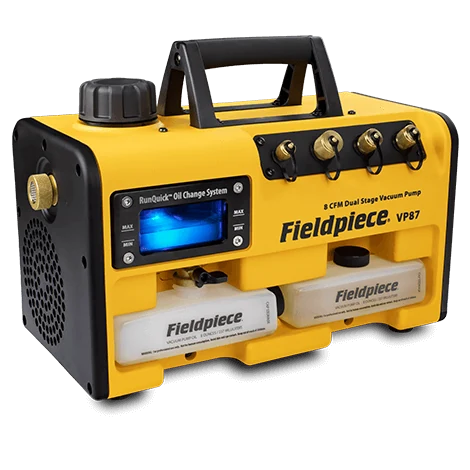
The manufacturer’s pump flyer describes the RunQuick oil-change arrangement and backlit reservoir. Treat its rapid-change timing as a manufacturer claim. The buying value is that routine oil care may be easier to integrate into the job, not that the pump becomes maintenance free.
The product-page guidance calls for attention to oil condition and removing old oil after the job. Build an oil supply, clean storage and disposal routine into ownership. We have not priced oil, replacement parts or repairs, and a single bottle included in a package is not a lifetime operating cost.
Ask the supplier to show access to the reservoir, drain and controls with the pump placed as you expect to use it. A feature is more valuable when it remains accessible beside your normal hose arrangement. Keep the full operating instructions available rather than relying on a remembered demonstration.
Electrical and refrigerant boundaries
The v14 manual specifies grounding and suitable extension cords, prohibits pumping hydrocarbons, and states that a vacuum pump is not a refrigerant recovery machine. Those distinctions matter when comparing tools for a shop that services several refrigerant families.
The VP87 product page identifies A2L certification. Match the exact pump, installed equipment, refrigerant and procedure before use; that label does not grant general permission for any gas or atmosphere. A recovery machine performs a different job and should remain a separate purchase decision.
VP87 or a smaller pump: compare the complete kit
Make a list of what you already own: gauge, hoses, fittings, oil supply and a suitable power arrangement. Then price the missing pieces. This is more informative than comparing bare-pump prices when one choice requires accessories you do not have.
A smaller pump may remain suitable when the present setup already meets the work requirement. The VP87 becomes more attractive when its documented capacity and oil-access features solve a demonstrated need. Neither conclusion requires a claim that one model is universally faster or more reliable than another.
Buying checklist
- Confirm the exact VP87 and regional electrical version against the nameplate.
- Check that your hoses and fittings match the intended ports and procedure.
- Include a suitable micron gauge, oil and service support in the total budget.
- Review transport, storage and safe access to the oil reservoir.
- Verify the selected seller’s authorization, return terms and warranty route.
The Amazon link identifies a VP87 listing, while seller authorization remains a separate check under Fieldpiece’s marketplace policy. Shortlist this pump for a complete evacuation workflow and evaluate a demonstration against your actual needs. This article offers research-based buying analysis; it does not report a completed field trial.
Manufacturer specification reference
Fieldpiece · VP87 · VP87 8 CFM Vacuum Pump
These are manufacturer specifications, not independently measured results.
- Nominal flow
- 8 CFM
- Ultimate vacuum at input ports
- 15 microns; a pump specification, not a completed-system target
- Pump and motor
- Two-stage rotary vane; 3/4 HP brushless DC motor
- Power
- 120 VAC, single phase; nominal 6 A
- Oil capacity
- 8 fluid ounces (237 mL)
- Input ports
- One 1/4-inch, two 3/8-inch and one 1/2-inch
- Empty weight
- 27 lb, per operator manual
Related BAS Bridge learning
Sources & verification
Follow the current manufacturer instructions for your exact model. Specifications and source revisions can change.
- Fieldpiece VP87 product specifications ↗
Model identity, nominal flow, pump-port ultimate vacuum, motor, port sizes, oil capacity and manufacturer A2L certification statement.
Checked Oct 29, 2026 · Source publication date: Unknown - Fieldpiece VP67/VP87/VPX7 operator manual v14 ↗
Model-specific technical table, empty weight, gauge-placement discussion, grounding/extension-cord guidance, hydrocarbon exclusion and separation from recovery work.
Checked Oct 29, 2026 · Source publication date: Unknown - Fieldpiece VPX7/VP87/VP67 product flyer v08 ↗
RunQuick oil-change feature, reservoir visibility and manufacturer positioning; no independent timing or comparative test.
Checked Oct 29, 2026 · Source publication date: Unknown - Fieldpiece online marketplace policy ↗
Marketplace authorization requirement, separate from listing identity.
Checked Oct 29, 2026 · Source publication date: Unknown - Amazon VP87 exact-model listing ↗
Purchase identity only: Amazon productTitle names Fieldpiece VP87 8 CFM vacuum pump and matching ASIN. No prices or customer-review content imported.
Checked Oct 29, 2026 · Source publication date: Unknown - Fieldpiece VP87 official product image ↗
Exact-model image linked from the manufacturer product page and visually checked for product identification. The image is not evidence of BAS Bridge ownership or testing.
Checked Oct 29, 2026 · Source publication date: Unknown
Editorial context
Prepared by BAS Bridge from linked manufacturer documentation and original buying analysis. This article does not claim firsthand use or independent performance measurements.
Manufacturer product information and operator documentation were checked on October 29, 2026. Practical buying conclusions are editorial analysis; no physical testing or service-call experience is claimed.
No current price, stock level, customer star rating, or measured reliability rate is implied.
Methodology & disclosure →