Quick verdict
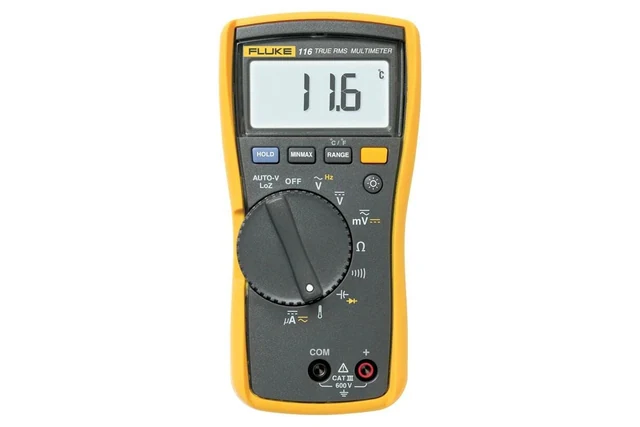
The Fluke 116 fits HVAC work that calls for flame-signal microamps, contact temperature and probe-based electrical checks. It needs a separate solution for ordinary motor current and 4–20 mA loop measurements, so judge the complete service kit against a clamp-centered alternative.
The main compromise is the kit around it. A technician who regularly measures blower or compressor current must account for a separate clamp instrument. Carrying two tools may be acceptable, but it changes the cost, storage and convenience comparison with a multifunction clamp meter.
Research basis
This article is based on manufacturer documents checked on October 29, 2026. We have not used this meter on a service call, checked its calibration or compared its durability with another instrument. The recommendations below are buying analysis, and every stated capability remains subject to its documented conditions.
Documented functions
The official Fluke 116 page identifies the following capabilities and supplied temperature accessory. Read the complete accuracy tables when a small difference in a reading would affect your diagnosis.
| Item | Documented specification |
|---|---|
| Electrical rating | CAT III 600 V |
| AC/DC microamps | 600.0 µA range; 0.1 µA resolution |
| Meter temperature range | −40 to 400 °C; probe limits and error also apply |
| DC voltage | Up to 600 V |
| Power | 9 V alkaline battery |
| Included temperature accessory | 80BK integrated temperature probe |
A range tells you what the meter can display. It does not say how much uncertainty applies to every reading. The thermocouple adds its own error, so the meter specification alone cannot establish the accuracy of the whole temperature measurement.
Can the Fluke 116 measure flame current and 4–20 mA?
The 600 µA range is 0.6 mA, so it does not cover a 4–20 mA control loop. The 116 also has no integral current clamp for ordinary motor or compressor current. If either measurement is routine, include the appropriate separate instrument in the kit decision rather than assuming the HVAC label covers every electrical task.
A flame-signal function is useful when the equipment documentation specifies a microamp test and describes the correct connection. The purchase question is how frequently you encounter that requirement and whether your present instrument can capture it appropriately. A rarely used function should have less weight than a daily measurement.
Plan the measurement before opening a circuit. Record the equipment model, prescribed procedure, operating condition and observed signal. Compare the result with that equipment's instructions. This review does not provide a universal passing flame-current value, because the applicable control and test arrangement determine the interpretation.
An unexpected result should lead to a distinguishing check. Consider the connection, reference, operating state and instrument setup before deciding that the flame rod or control has failed. The value of owning the function is access to evidence; it does not make one reading a complete diagnosis.
LoZ needs a deliberate choice
Fluke describes low input impedance as a way to reduce misleading ghost-voltage readings. Its shared 114/115/116/117 safety instructions caution against Auto-V LoZ on circuits that could be damaged by its approximately 3 kΩ input. That limitation matters when moving between power wiring and electronic controls.
The practical buying implication is training and function selection. A convenient automatic mode can still be the wrong measurement load for a particular signal. Before making a comparison, identify whether the circuit permits that load and what the manufacturer expects you to observe.
For BAS work, avoid treating every electrical signal as the same task. A supply-voltage question, a sensor-resistance check and a sensitive controller-output question call for different arrangements. Choose the meter and function around the signal rather than beginning with the rotary-switch position you used on the last job.
Temperature and capacitance in a service bag
Contact temperature can complement electrical observations, provided the probe suits the surface, medium and temperature. Consider the accessory you actually need: a general probe and a pipe-contact arrangement solve different access problems. Do not assume the supplied accessory is ideal for every HVAC measurement.
For a repeatable temperature comparison, document probe placement, contact and stabilization as well as the displayed value. A change in position can undermine the comparison even when the meter itself behaves consistently. This is a measurement-planning consideration, not a report of a defect in the 116.
The manufacturer safety instructions require disconnecting power and discharging high-voltage capacitors before resistance, continuity, diode or capacitance testing. A capacitance function does not justify shortcuts around stored energy. The equipment procedure and safe isolation remain part of the work.
Fluke 116 or a clamp meter: compare the whole kit
List your common jobs before comparing models. If most calls demand clamped current first, a clamp-centered tool may reduce how often you change instruments. If microamps and direct probe measurements dominate, the 116's layout may make more sense. We have not measured either workflow's speed.
Consider the Fieldpiece SC260 review as a comparison of a different instrument format. Compare the functions you require individually rather than assuming that a larger feature count means fewer service limitations.
Ownership and buying checklist
- Confirm the standalone 116 and included accessories, rather than assuming a 116/323 bundle is the same offer.
- Inspect the required lead, clip and temperature-probe options for your work.
- Include a suitable current clamp if motor-current measurement is part of the kit.
- Check the seller, condition, warranty route and any required calibration documentation.
Current purchase and service prices have not been verified. Ask about replacement leads, probe availability, calibration turnaround and a backup arrangement before a busy season. These costs can matter more than a small difference between advertised meter prices.
Buy the 116 when its measurement set fits a defined gap in your bag. Its appeal is a purposeful HVAC multimeter with useful specialist functions. Claims about years of reliability, superior accuracy in practice or faster diagnoses would require testing that this article does not provide.
Manufacturer specification reference
Fluke · 116 · 116 HVAC Multimeter
These are manufacturer specifications, not independently measured results.
- Electrical rating
- CAT III 600 V
- AC/DC microamps
- 600.0 µA range; 0.1 µA resolution
- Meter temperature range
- −40 to 400 °C; probe limits and error also apply
- DC voltage
- Up to 600 V
- Power
- 9 V alkaline battery
- Included temperature accessory
- 80BK integrated temperature probe
Related BAS Bridge learning
Sources & verification
Follow the current manufacturer instructions for your exact model. Specifications and source revisions can change.
- Fluke 116 official product specifications ↗
Exact 116 identity, microamp and temperature functions, ranges, safety category and included accessories. Manufacturer claims are not independent test results.
Checked Oct 29, 2026 · Source publication date: Unknown - Fluke 114/115/116/117 calibration safety information ↗
Manufacturer safety instructions including the warning against using Auto-V LoZ on circuits that could be damaged by its approximately 3 kΩ input, and isolation before resistance/capacitance tests.
Checked Oct 29, 2026 · Source publication date: Unknown - Fluke 116 official product image ↗
Exact-model image linked from the manufacturer product page and visually checked for product identification. The image is not evidence of BAS Bridge ownership or testing.
Checked Oct 29, 2026 · Source publication date: Unknown
Editorial context
BAS Bridge editorial prepared this documentation-based research overview and buying analysis. No firsthand experience, physical measurement or independent performance test is claimed.
Manufacturer documentation checked on October 29, 2026. Buying recommendations are original editorial interpretation of that documentation, with no physical product testing.
No current price, stock level, customer star rating, or measured reliability rate is implied.
Methodology & disclosure →