Quick verdict
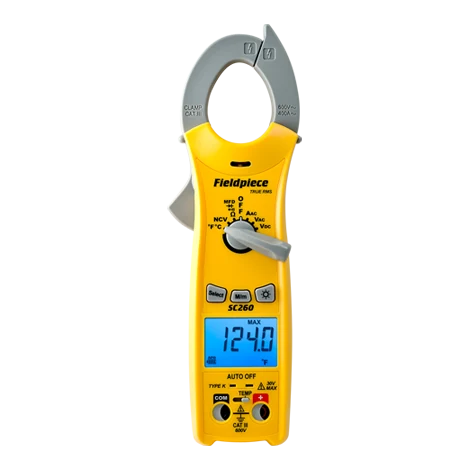
The Fieldpiece SC260 suits routine HVAC/R checks that need a compact 400 A AC clamp meter with voltage, capacitance, and contact temperature. Its decisive omissions are DC microamps for flame-current checks and true inrush capture. Buyers who need either function should compare another instrument before choosing it for bag space alone.
Reasons to consider it: AC current, AC/DC voltage, capacitance, and contact temperature in one compact instrument; a magnet and backlight; a straightforward alternative to carrying a larger multifunction meter.
Reasons to choose something else: No DC microamp function for flame-current checks; min/max is not true inrush capture; no wireless logging; field comfort and long-term durability remain untested here.
This is a research-based Fieldpiece SC260 review based on manufacturer documentation and analysis of its stated capabilities. We have not used this meter on service calls, measured its accuracy, or verified its performance in sunlight, with gloves, or after repeated drops.
What the SC260 covers
The Fieldpiece product page lists these core capabilities and package contents:
| Item | What matters when buying |
|---|---|
| Clamp current | Up to 400 A AC; this is not a DC-current clamp |
| Voltage | AC/DC measurements up to 600 V |
| Other functions | Capacitance, resistance, continuity, diode test, contact temperature, and non-contact voltage detection |
| Display and handling | Backlit LCD, hold, min/max, and swivel magnet |
| Standard package | Meter, silicone test leads, Type K thermocouple, strap, battery, and padded case |
The function list is a useful starting point, but the job should drive the purchase. Write down the measurements you actually make over a working week. A technician who mainly checks contactors, control voltage, running amperage, and capacitors has a different requirement from someone diagnosing ignition controls or investigating motor starting behavior.
That exercise also helps an apprentice buy in stages. A tool can be a sensible first meter even if it will eventually need a companion. It becomes an expensive mistake when a missing function is discovered during the job that justified buying it.
Does the SC260 measure flame-sensor microamps or inrush?
Fieldpiece specifies true-RMS AC measurements. The SC260 manual also sets frequency and waveform limits; true RMS should not be read as unlimited accuracy on every drive output. The manual rates the instrument CAT III 600 V and gives a 30 mm jaw opening. Its indoor-use classification and environmental limits deserve attention if you work in exposed locations. These are manufacturer specifications, not independent test results.
For a service bag, the more useful question is whether the meter lets you complete the measurement without an awkward setup. A current range can be adequate while the jaw is still difficult to position around the intended conductor. We would check access on the equipment you service before treating small overall size as proof of easy access everywhere.
Current, voltage, resistance, and temperature answer different questions. A running-current reading can support a diagnosis without establishing the condition of a compressor by itself. Likewise, resistance between terminals does not turn this instrument into a dedicated insulation tester. Avoid buying it on the assumption that a long resistance range replaces the test method specified by the equipment manufacturer.
The important omission for gas-heating work is DC microamps. If flame-rectification checks are routine, choose a suitable meter that explicitly includes that measurement, or budget for a separate instrument. Trying to work around the missing function defeats the purpose of selecting a compact, convenient meter.
There is a second distinction for motor work. Fieldpiece’s SC260 FAQ explicitly says min/max cannot substitute for inrush capture. Min/max can help watch a changing reading, but it is not evidence that the starting-current peak has been captured. If start-up measurements are central to your work, put a dedicated inrush function on the shopping list.
Daily use: the details worth checking
The magnet is potentially useful when you need the display in view while placing leads. Its practical value depends on having a suitable mounting surface, enough lead length, and a position that does not put the meter or its leads in the way. Think through where you would hang it inside a furnace cabinet or beside a rooftop disconnect.
A backlight addresses low light. It does not establish readability under direct sun, through scratched plastic, or from an oblique angle. For a technician who works outdoors most days, a store demonstration or a return option is more useful than assuming all backlit displays behave alike.
We would also try the selector and buttons while wearing the gloves normally used for the task. Can you distinguish a button press from a long press? Can you confirm the selected function at a glance? Does the meter sit securely in your hand without blocking the display? These are buying checks, not positive or negative findings from this review.
Lead management deserves the same attention as the meter body. A meter that fits a pocket can still become cumbersome once the leads, clips, and temperature probe are added. Decide whether the instrument will be carried in a pouch, a backpack, or a separate electrical compartment, and judge the complete package that way.
The manual’s safety instructions require damaged leads to be replaced and capacitors to be isolated and safely discharged before capacitance testing. Its non-contact detector is an indication feature; follow the applicable electrical safety procedure and the instrument instructions for the work being performed. A convenient alarm is not a reason to skip verification.
Ownership cost and buying from Amazon
The cost of a meter includes the accessories that keep the measurement useful. Before ordering, check the replacement lead set, appropriate clips, a temperature probe suited to the task, battery supply, and service arrangements. We have not verified current accessory prices, so none are presented as fixed ownership costs.
An inexpensive probe that gives a poor contact temperature reading can create more uncertainty than a more expensive meter body resolves. When comparing packages, ask which probe is actually included and whether it suits air, surface, or pipe measurements. A generic description such as “temperature included” does not settle that question.
Seller identity matters as well as the ASIN. Fieldpiece’s marketplace policy requires its written authorization for marketplace sellers, and the SC260 manual describes a one-year limited warranty for purchases from authorized dealers. We have not confirmed the authorization of every seller that may appear on Amazon. Check the seller with Fieldpiece before purchase, particularly when warranty support affects the decision.
Keep the invoice and package details. A product page can combine offers from different sellers, and an affiliate link identifies a destination rather than certifying a seller. Compare the actual offer, accessories, return terms, and support route at checkout.
SC260 alternatives: what would justify moving up?
The most defensible reason to buy a different meter is a needed measurement, rather than a longer feature list. For example, the Fluke 902 FC includes DC microamp measurements up to 200 µA and Fluke Connect support. That makes it relevant to a buyer who needs flame-current checks or wireless measurement records. This research does not establish that it is more accurate, more comfortable, or more durable than the SC260.
Another option is to keep an existing suitable electrical meter and add a task-specific instrument only when a recurring gap becomes clear. That can be a better use of the budget than replacing a working meter solely to consolidate equipment.
Use a structured buying checklist: start with required functions, then assess safety ratings, useful ranges, access, and handling. Do not let brand familiarity or a high customer score reverse that order.
Who should consider the Fieldpiece SC260?
Consider it if you want a compact instrument for routine HVAC/R electrical checks and can clearly identify the measurements handled elsewhere in your kit. It is especially worth evaluating when bag space and carrying weight matter, but you do not need wireless records or advanced starting-current functions.
Choose another model if DC microamps or true inrush capture must be available in the same meter. If those measurements are only occasional, compare the cost and inconvenience of a second instrument before deciding.
The SC260’s value rests on matching a focused tool to a real workload. Confirm that match, inspect the exact package and seller, and leave room in the budget for suitable leads and probes. That is a stronger buying basis than treating popularity as a performance test.
Manufacturer specification reference
Fieldpiece · SC260 · SC260 Compact Clamp Meter
These are manufacturer specifications, not independently measured results.
- AC current
- Up to 400 A; true RMS within stated frequency and waveform limits
- Voltage
- Up to 600 V AC/DC
- Safety category
- CAT III 600 V
- Jaw opening
- 30 mm
- Functions
- Capacitance, resistance, continuity, diode, Type K contact temperature, NCV, hold, min/max
- Inrush
- Not provided; manufacturer FAQ explicitly says min/max is not inrush
- DC microamps
- Not a listed or supported function
Related BAS Bridge learning
Sources & verification
Follow the current manufacturer instructions for your exact model. Specifications and source revisions can change.
- Fieldpiece SC260 product specifications and FAQs ↗
Official documentation consulted for the documented capabilities and limitations. The article distinguishes source specifications from editorial interpretation.
Checked Oct 29, 2026 · Source publication date: Unknown - Fieldpiece SC260 operator manual v22 ↗
Official documentation consulted for the documented capabilities and limitations. The article distinguishes source specifications from editorial interpretation.
Checked Oct 29, 2026 · Source publication date: Unknown - Fieldpiece online marketplace policy ↗
Official documentation consulted for the documented capabilities and limitations. The article distinguishes source specifications from editorial interpretation.
Checked Oct 29, 2026 · Source publication date: Unknown - Fluke 902 FC official specifications ↗
Official documentation consulted for the documented capabilities and limitations. The article distinguishes source specifications from editorial interpretation.
Checked Oct 29, 2026 · Source publication date: Unknown - Fieldpiece SC260 official product image ↗
Exact-model image linked from the manufacturer product page and visually checked for product identification. The image is not evidence of BAS Bridge ownership or testing.
Checked Oct 29, 2026 · Source publication date: Unknown
Editorial context
Published by BAS Bridge from linked manufacturer documentation and original buying analysis. The review does not claim firsthand experience or independent performance measurements.
Manufacturer product information and operator documentation were checked on October 29, 2026. Practical buying conclusions are editorial analysis; no physical testing or service-call experience is claimed.
No current price, stock level, customer star rating, or measured reliability rate is implied.
Methodology & disclosure →