Quick verdict
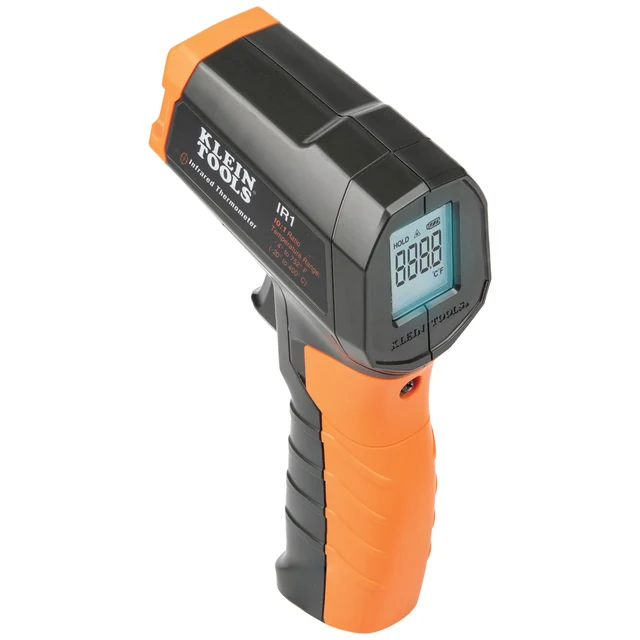
The Klein IR1 is a standalone infrared thermometer for surface-temperature checks, with a 10:1 distance-to-spot ratio and fixed 0.95 emissivity. Consider it when the target fills the sensing area and the surface suits infrared measurement. Choose a suitable probe for air or contact readings; the laser dot does not define the measured area.
For HVAC work, it should be selected as a surface thermometer. A displayed number from a register, pipe, or cabinet does not automatically answer a question about air temperature, internal fluid temperature, or a complete system’s condition.
This review uses manufacturer documentation. We have not tested its accuracy, outdoor readability, or performance on equipment.
Pros supported by the design
- A standalone display and laser aiming aid.
- A broad stated surface-temperature range.
- Automatic hold for reviewing a reading after releasing the trigger.
Limitations to consider
- Fixed emissivity limits adaptability to different surface finishes.
- The sensing area grows as you move away from the target.
- No air probe, contact probe, or thermal image is included.
Specifications that matter
Klein lists a -4 to 752°F (-20 to 400°C) measurement range, a 10:1 distance-to-spot ratio, and fixed emissivity of 0.95. The package includes a pouch and one 9V battery. Its backlit display is a documented feature; visibility in direct sunlight has not been evaluated here. Klein IR1 specifications.
The product announcement also identifies the tool as a fixed-emissivity, single-laser thermometer. It is not a thermal imaging camera or a device that displays a temperature map. Klein IR1 announcement.
What does the Klein IR1 10:1 spot ratio mean?
The laser assists aiming; it does not make the sensing area as small as the visible dot. The instruction manual illustrates a roughly one-inch measurement area at ten inches and a two-inch area at twenty inches. A small target surrounded by material at a different temperature may therefore produce a reading that includes more than the target you intended. IR1 manual, targeting section.
A practical buying question follows: can you position the instrument close enough to fill its sensing area with the surface of interest? If you frequently look across a room at small components, compare the required target size and access before choosing a thermometer. A larger distance-to-spot specification can matter for that task, but it does not remove the need to understand the material being viewed.
Consider a narrow pipe against a warm background. Putting the laser dot on the pipe is not sufficient evidence that the measurement contains only the pipe. The relevant geometry is the full sensing area. That is why this tool’s convenient aiming feature should not be confused with proof of a precise, isolated measurement. The general relationship between target size, distance, and background is also explained in Fluke’s infrared application note.
Fixed emissivity and reflective metal
Emissivity describes how a surface emits infrared energy relative to an ideal reference. The IR1 fixes its setting at 0.95. The manual warns that reflective materials can be hotter than the indicated result. Surface suitability matters; a clean numerical display cannot correct a mismatch by itself. IR1 specifications, IR1 safety and measurement guidance.
For a purchase decision, think about the materials you actually inspect. If the central task is a temperature value on reflective tubing, make a suitable contact method part of the comparison. If your task is scanning comparable nonreflective surfaces for a substantial difference, an infrared format may be more convenient. That is a reasoned distinction between tasks, not a measured finding about this IR1 sample.
Consistency also matters when comparing readings. Changing the finish, angle, distance, or portion of the target changes the question being asked. A repeatable approach is more useful than collecting many numbers without knowing whether they represent comparable surfaces. Fluke’s general infrared guidance discusses reflected energy and contact checks; this supports the measurement principle, not a claim about IR1 performance.
Accuracy and useful expectations
The manual states an allowance of ±4°F or ±2%, whichever is greater, at or above freezing under its specified conditions. It adds separate qualifications for lower temperatures and ambient conditions. We would use the exact supplied manual for tolerance-sensitive work rather than applying a single best-case figure across the entire advertised range. IR1 measurement specifications.
The buying implication is straightforward: do not choose it for a decision that requires confidence in tiny temperature differences merely because the display shows tenths. A broad, repeatable difference and a close tolerance are different requirements. Select the instrument after deciding which requirement your work presents.
A backlight and hold feature can help you manage the reading process, but neither proves accuracy. We also have no firsthand evidence here for the trigger feel with gloves, resistance to repeated truck storage, or readability with glare behind the operator.
Klein IR1 vs a probe thermometer for HVAC
For supply or return air, compare a suitable probe arrangement. Reading the grille’s surface is a different measurement from sampling the air. Our Klein ET05 review covers a compact local probe option and a documentation issue to resolve before relying on its accuracy.
For a measurement point you cannot see safely, a laser does not solve the access problem. For an image of a broad surface with several temperature zones, compare thermal imaging equipment. For a repeated contact reading, compare contact instruments and attachments. Those choices begin with the measurement, not a desire to make one inexpensive tool cover every task.
The IR1 remains a reasonable candidate when a basic standalone surface thermometer answers the actual question. Check that the fixed-emissivity design and sensing area suit your targets, confirm the package, and consider seller and return terms. We have not verified live replacement-battery prices or a current purchase price.
Final recommendation
Consider the Klein IR1 for suitable surface-temperature surveys where you understand the target geometry and material. Choose a probe when you need air or contact temperature, and choose a more specialized instrument when your tolerance or reporting requirements demand it. Follow the laser warnings: avoid directing the beam toward eyes or situations where another person may be exposed. Klein IR1 warnings.
The case for buying it is convenience within that scope. Actual comparative accuracy and long-term durability remain untested by this site.
Manufacturer specification reference
Klein Tools · IR1 · IR1 Infrared Thermometer
These are manufacturer specifications, not independently measured results.
- Measurement range
- -4 to 752°F (-20 to 400°C)
- Distance-to-spot
- 10:1
- Emissivity
- Fixed 0.95
- Power
- One 9V battery
- Included
- Thermometer, pouch, 9V battery
- Measurement
- Surface temperature; no contact or air probe
Related BAS Bridge learning
Sources & verification
Follow the current manufacturer instructions for your exact model. Specifications and source revisions can change.
- Klein IR1 specifications ↗
Official documentation consulted for the documented capabilities and limitations. The article distinguishes source specifications from editorial interpretation.
Checked Oct 29, 2026 · Source publication date: Unknown - Klein IR1 instruction manual ↗
Official documentation consulted for the documented capabilities and limitations. The article distinguishes source specifications from editorial interpretation.
Checked Oct 29, 2026 · Source publication date: Unknown - Klein IR1 product announcement ↗
Official documentation consulted for the documented capabilities and limitations. The article distinguishes source specifications from editorial interpretation.
Checked Oct 29, 2026 · Source publication date: Unknown - Fluke infrared thermometer application note: targeting and reflection ↗
Official documentation consulted for the documented capabilities and limitations. The article distinguishes source specifications from editorial interpretation.
Checked Oct 29, 2026 · Source publication date: Unknown - Klein Tools IR1 official product image ↗
Exact-model image linked from the manufacturer product page and visually checked for product identification. The image is not evidence of BAS Bridge ownership or testing.
Checked Oct 29, 2026 · Source publication date: Unknown
Editorial context
Published by BAS Bridge from linked manufacturer documentation and original buying analysis. The review does not claim firsthand experience or independent performance measurements.
Manufacturer product information and operator documentation were checked on October 29, 2026. Practical buying conclusions are editorial analysis; no physical testing or service-call experience is claimed.
No current price, stock level, customer star rating, or measured reliability rate is implied.
Methodology & disclosure →