Quick verdict
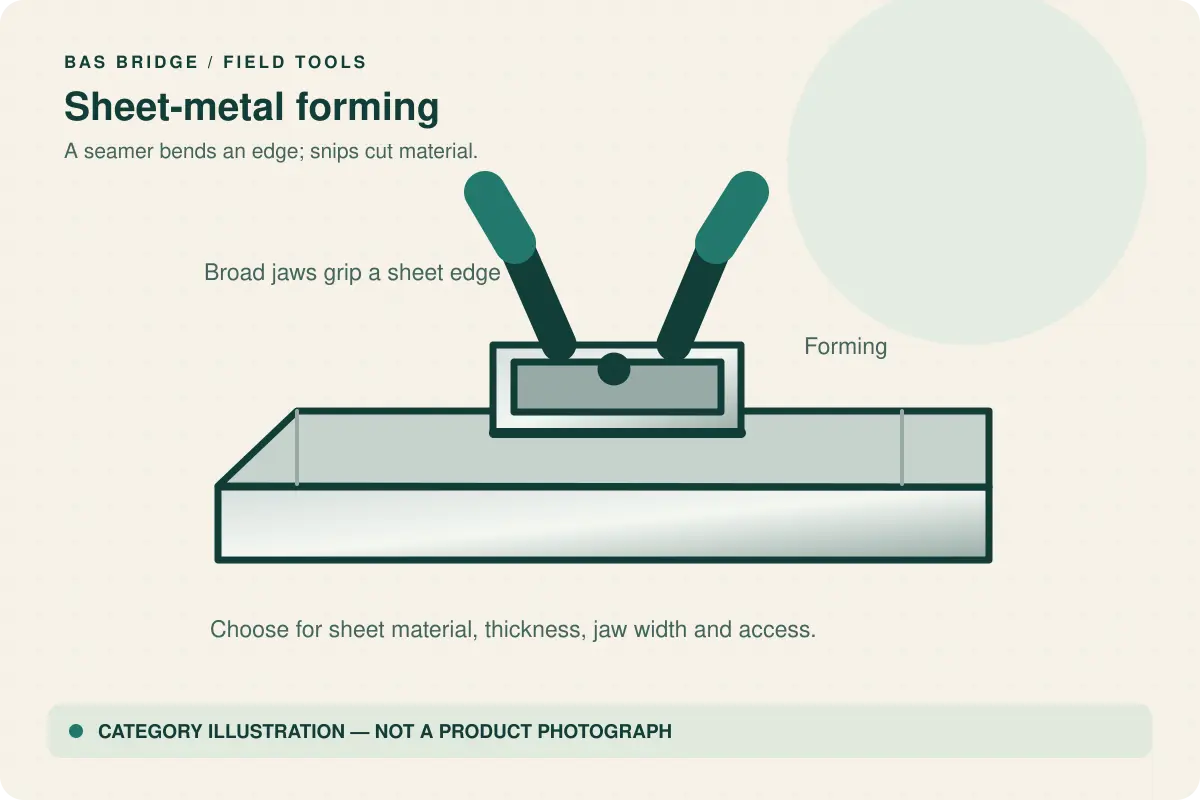
The S2R is a sensible candidate for local bends, hems, and sheet-metal corrections where a short hand seamer fits. Its compact jaw span is the reason to consider it and the reason to choose a longer forming tool for long, visually straight folds.
This is a research-based review of the exact model, using the linked official documentation and original buying analysis. We have not performed hands-on or comparative testing. Amazon customer reviews and star ratings are not reproduced or represented as independent evidence.
Match the S2R to the bend, not just the tool name
The official Malco catalog describes the S2R as a hand seamer with high-carbon-steel forged jaws. Its actual jaw width is 3-1/4 inches, its jaw depth is 1-1/4 inches, and the jaws have quarter-inch depth markings. The familiar three-inch-class description should not replace these actual dimensions when checking access.
Jaw width determines how much of the bend the tool controls at once. Jaw depth limits how far a sheet edge can engage. Those dimensions address different problems: a narrow opening may accept the width while a deep intended flange exceeds the available engagement. Measure the part before assuming that a compact seamer will reach the required bend line.
Why depth markings are useful
A depth reference helps keep several adjacent bends at a consistent distance from the edge. For example, a short flange on a repair panel needs more than a roughly correct angle; the bend line also needs to stay straight enough for the panel to fit. Markings provide a reference that can be checked against the layout.
They do not measure the final bend angle or guarantee the edge was square to begin with. A damaged or tapered reference edge can still produce a changing flange depth. Check the workpiece and the marked line, rather than treating the tool’s graduations as an independent inspection of the part.
Good tasks for a short hand seamer
A compact seamer is useful to consider for a short duct flange, a small hem, or a local adjustment where a larger folding tool has poor access. It concentrates control on a limited section. That is a job-fit conclusion from the tool geometry, not a claim that this sample has been tested on a particular duct.
It also belongs later in the workflow than a cutting tool. First establish the correct blank dimensions and the finished joint detail. Using the seamer to compensate for an incorrectly sized part can move the error somewhere else, especially where several flanges must line up at the same time.
The tradeoff on long folds
A long bend made with short jaws requires successive placements. Small differences in engagement or angle can accumulate into a wavy edge. A wider folding tool or an appropriate brake may suit that job better because it controls more of the bend at once.
That does not make the smaller seamer redundant. Long-fold capability and tight-access capability solve different problems. If your work alternates between bench fabrication and adjustments around installed ductwork, a short hand seamer can complement larger forming tools rather than replacing them. Choose based on the proportions of the parts you actually handle.
Inspecting and maintaining the working surfaces
The jaw surfaces are part of the finished result. Inspect alignment, contamination, and visible damage before using the tool on material where surface appearance matters. A piece of trapped debris or a damaged contact area can affect the sheet even when the bend location is correct. No independent surface-finish test was performed for this review.
Follow Malco’s current instructions for material capacity and tool care. Do not infer a stainless-steel thickness rating from a mild-steel rating or from the fact that the jaws are forged. The material’s resistance to bending and the allowable load on the tool both matter.
Buying the correct model
Compare the S2R model and dimensions with the actual offer. The source used here includes a dated manufacturer catalog, so confirm current package contents, availability, and instructions with the seller or manufacturer. No current price or unchanged production specification is promised by the publication date of this review.
Buy the S2R when local forming control is the missing capability in your kit. Compare a larger seamer or a brake when the main frustration is a long straight fold. The useful outcome is a part that fits and a repeatable bend, rather than simply having more leverage in your hand.
Reasons to consider it
- The documented 3-1/4-inch jaw width suits localized forming.
- The 1-1/4-inch jaw depth provides a defined working envelope.
- Quarter-inch depth markings help repeat a chosen engagement depth.
Tradeoffs to consider
- A short jaw span does not form a long fold in one operation.
- Material and thickness limits must be matched to the current instructions.
- We have not measured jaw alignment, grip effort, or surface marking on a sample.
Manufacturer specification reference
Malco · S2R · Malco S2R Hand Seamer
These are manufacturer specifications, not independently measured results.
- Actual jaw width
- 3-1/4 inches
- Jaw depth
- 1-1/4 inches
- Jaw material
- Forged high-carbon steel
- Depth markings
- 1/4-inch increments
Related BAS Bridge learning
Sources & verification
Follow the current manufacturer instructions for your exact model. Specifications and source revisions can change.
- Hand Seamer ↗
Official model documentation checked for the features and limits discussed in this original research review. Specifications are manufacturer claims; buying judgments are editorial analysis.
Checked Nov 2, 2026 · Source publication date: Unknown
Editorial context
Independently written BAS Bridge research review. Manufacturer features are distinguished from editorial judgments. No firsthand use or measured comparative performance is claimed. Amazon customer reviews and star ratings are not copied or synthesized into ratings.
The linked official product documentation was checked on November 2, 2026. This article combines documented features with original task-based analysis. No physical testing, service-call use, Amazon customer-review consensus or independent performance measurement is claimed.
No current price, stock level, customer star rating, or measured reliability rate is implied.
Methodology & disclosure →