Quick verdict
The VP67 is worth considering when a six-CFM corded pump and convenient oil service fit the work. Its rated flow and ultimate vacuum do not predict how quickly a wet, restrictive, or poorly connected system will evacuate.
This is a research-based review of the exact model, using the linked official documentation and original buying analysis. We have not performed hands-on or comparative testing. Amazon customer reviews and star ratings are not reproduced or represented as independent evidence.
The specifications that affect the decision
Fieldpiece lists the VP67 as a 6 CFM, two-stage rotary-vane pump with a 1/2 HP AC motor, a 15-micron ultimate vacuum at the inlet ports, and a 29 lb weight. The pump provides several inlet sizes and the RunQuick oil-change arrangement. These are useful buying facts; they are not a prediction that a connected refrigeration circuit will reach 15 microns or finish in a particular number of minutes.
The rated flow identifies one part of the evacuation system. Hose diameter and length, valve cores, adapters, and the condition of the circuit can become the limiting elements. A larger number printed on a pump cannot force unrestricted flow through a restricted service path. Compare the whole arrangement before deciding that a higher-CFM model is the only sensible upgrade.
Oil service is a meaningful feature
An oil-sealed pump depends on suitable oil in suitable condition. The RunQuick layout is interesting because it can make an oil change less disruptive, which is valuable only if the operator actually monitors and maintains the oil. Convenient service access is a practical design benefit; it should not be translated into an unsupported claim about hours saved on every job.
Plan for clean oil, sealed storage, and the manufacturer’s maintenance procedure. Moisture and contamination removed from a circuit can compromise the oil during the evacuation. If progress slows, the useful question is what the measurements and setup suggest about the cause, rather than whether the pump has enough nominal CFM to satisfy an arbitrary rule of thumb.
A low pump reading is not the finished result
The 15-micron specification describes ultimate vacuum at the input ports under stated conditions. It is not a universal target for every appliance and is not evidence that every part of a connected system is dry. The equipment manufacturer’s evacuation and standing-test requirements determine the completion criteria.
Gauge placement matters because a reading close to the pump can be influenced by the path between the gauge and the rest of the circuit. A system-side gauge and a suitable isolation method help make the observation more representative. If a standing test fails, investigate the arrangement as well as the equipment before deciding that the pump is defective.
Portability and the VP87 comparison
The VP67’s 29 lb published weight should be considered alongside how the tool will travel. A pump carried from the van to a ground-level condenser presents a different handling problem from one moved repeatedly to rooftops. Compare actual weight, motor arrangement, oil access, and the supply conditions with the VP87 rather than assuming the six-CFM model is always the more portable option.
Our verdict is based on the documented design. We have not timed evacuations, measured cold starting, checked noise, or compared pumps on identical wet systems. Buy the VP67 when its capabilities fit a well-planned setup and its transport burden is acceptable. Include oil, hoses, core tools, a micron gauge, and routine care in the real cost.
Does six CFM mean a predictable evacuation time?
No. Flow restrictions, circuit volume, moisture, oil condition, and the required completion test all affect the job. Rated pump flow is only one input.
Can a vacuum pump recover refrigerant?
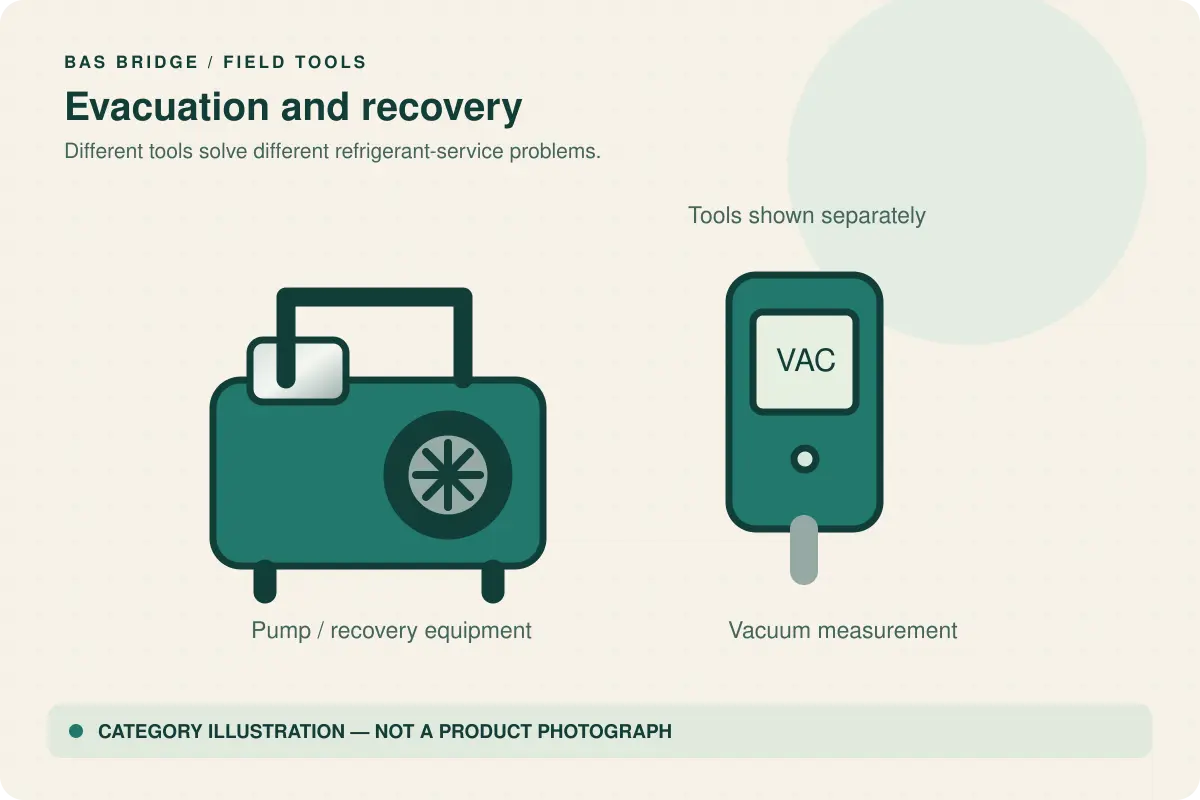
No. Refrigerant recovery and evacuation are separate tasks requiring suitable equipment and procedures. The VP67 is an evacuation pump.
Reasons to consider it
- Six-CFM two-stage design with multiple inlet sizes
- RunQuick oil-change system supports oil maintenance during the job
- Visible reservoir helps the operator inspect the oil condition
Tradeoffs to consider
- 29 lb manufacturer weight matters for transport
- Pump performance cannot remove restrictions elsewhere in the arrangement
- No independent evacuation-time or ultimate-pressure testing was performed
- Predicting evacuation time from the CFM number alone
- Replacing refrigerant recovery equipment
Manufacturer specification reference
Fieldpiece · VP67 · Fieldpiece VP67 Six-CFM Vacuum Pump
These are manufacturer specifications, not independently measured results.
- Rated flow
- 6 CFM
- Pump
- Two-stage rotary vane
- Motor
- 1/2 HP AC
- Stated ultimate vacuum
- 15 microns at inlet ports
- Weight
- 29 lb
Related BAS Bridge learning
Sources & verification
Follow the current manufacturer instructions for your exact model. Specifications and source revisions can change.
- Fieldpiece VP67 official product information ↗
Official model documentation checked for the features and limits discussed in this original research review. Specifications are manufacturer claims; buying judgments are editorial analysis.
Checked Nov 2, 2026 · Source publication date: Unknown
Editorial context
Independently written BAS Bridge research review. Manufacturer features are distinguished from editorial judgments. No firsthand use or measured comparative performance is claimed. Amazon customer reviews and star ratings are not copied or synthesized into ratings.
The linked official product documentation was checked on November 2, 2026. This article combines documented features with original task-based analysis. No physical testing, service-call use, Amazon customer-review consensus or independent performance measurement is claimed.
No current price, stock level, customer star rating, or measured reliability rate is implied.
Methodology & disclosure →